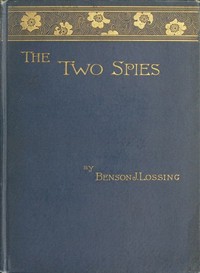
The Two Spies: Nathan Hale and John André — Reading Notes

(0 User reviews)   1429
Lossing, Benson John, 1813-1891, Seward, Anna, 1742-1809 [Contributor], Rosa, H. [Illustrator] Project Gutenberg 2020 Not confirmed
Hale, Nathan, 1755-1776; André, John, 1751-1780 Readers of public-domain and historical texts
Project Gutenberg digital edition en

Edition facts

Words 46,166
Reading time 201 min
Text sections 19

For The Two Spies: Nathan Hale and John André — Reading Notes, the stored edition analysis reports 46,166 words, 3 hr 21 min estimated reading time, and 19 detected text sections.

The text analysis averages about 20.1 words per sentence, while the detected sections provide another way to judge how the source is divided.

Project Gutenberg metadata also associates the work with “Hale, Nathan, 1755-1776,” connecting these edition facts with the source record’s subject description.

Benson J. Lossing's 1886 dual biography contrasts the motives and fates of Nathan Hale and John André, using primary sources like Hale's last words and André's capture narrative to examine honor, patriotism, and espionage in the American Revolution.
Share
Editorial Edition Score 4.8/5

Calculated from edition completeness, EPUB availability, text structure and catalogue metadata. Not a user rating.

How this score is calculated
  • Description quality20 pts
  • Title & short description10 pts
  • Source metadata20 pts
  • Text length15 pts
  • Chapters / structure15 pts
  • EPUB file integrity20 pts

Total of 100 points, scaled to a 2.5-5.0 range. Editions with an empty description or a missing EPUB file are not scored.

Edition quality

Read the Text

Hale's Birthplace and Parentage.--The Hale Family 3

Hale's Youthhood and Education 4

Dr. Munson's Recollections of him 5

Hale at Yale College and as a School-teacher 7

His Military Career at Boston and New York 9-12

The American Army at New York 12, 13

A Man for Secret Service sought 18

Hale's Idea of the Service; he volunteers 14

His Career as a Spy 15-20

Taken to General Howe's Headquarters 19

Sentenced to be hanged without Trial.--Great Fire in New York 20

Hale at the Place of Execution 21

Cruelly treated by Cunningham, the Provost-Marshal 22

Sympathy, expressed; his Execution 24

Monumental Memorials of Hale 25-27

Literary Contributions to his Memory 27-31

Tribute to Hale by Henry J. Raymond 31

Proposed Monument in Memory of Hale at New York 33

André's Birth, Parentage, Education, and Family 37

His Acquaintance with Anna Seward and her Literary Friends 38

His Betrothal to Honora Sneyd 40

His Correspondence with Miss Seward 41

Presaging Omens 42, 43

André goes to America 43

At Philadelphia--his Accomplishments and Captivating Manners 45

Lord Howe entertained 45

The Mischianza described by André 46-59

The Mischianza and the Character of General Howe criticised 59, 60

The British fly from Philadelphia toward New York, General Clinton in Command.--Battle of Monmouth 60

Expedition to Rhode Island 61

André's Genius and Social Position 62

His Letter to Benedict Arnold's Wife 63

Arnold's Career in Philadelphia 63, 64

His Treasonable Correspondence with Sir Henry Clinton and André 64, 65

André a Spy in Charleston 66

Arnold's Premeditated Treason.--Occasion of "The Cow-Chase" 67

Gloomy State of Public Affairs.--Proposed Personal Meeting between Arnold and André 79

Arrangements for such a Meeting 79, 80

André at a Dinner-Party 80, 81

Goes to meet General Arnold 81

They go to Smith's House 83

The Terms of Treasonable Service agreed upon.--André compelled to attempt a Return to New York by Land 84

Receives Papers from Arnold.--His Journey.--The Neutral Ground 85

Patriotism of his Captors 88

André discovered to be a Spy 90

His Letter to Washington 91-93

Washington returns from Hartford at a Critical Moment.--Arnold receives Notice of André's Arrest 93

Painful Interview with his Wife.--He escapes to the _Vulture_ 94

Washington at Arnold's Quarters.--Discovers Arnold's Treason.--His Calmness and Tenderness 96

André brought to Arnold's Quarters and sent to General Greene at Tappaan 97

His Free Conversation with Major Tallmadge 98

Effects of the News of his Capture 99

Tried by a Board of Officers and condemned as a Spy 100

Efforts to save him 101

His Choice of the Mode of Death 102

His Execution 103-105

Almost Universal Sympathy felt for André 105, 106

Honored by his King 106

A Monument to his Memory in Westminster Abbey, described 106-108

André's Remains removed to the Abbey 108

Memorials to mark the Place of his Execution 109-115

Memorial-Stone erected by Mr. Field at Tappaan 110-115

Mr. Field's Generous Proposition 110, 114, 118

Attempts to destroy the Field Memorial at Tappaan 117, 118

An Indignation Meeting at Tappaan 119

A Monument to mark the Place where André was captured at Tarrytown 119-121

Biographical Sketch of Anna Seward 125

Monody on Major André 135

André's Letters to Miss Seward 152

Nathan Hale's Birthplace _Frontispiece_

Fac-simile of Hale's Handwriting 6

Union Grammar School-house at New London 8

The Beekman Mansion 18

Beekman's Greenhouse 19

Cunningham destroying Hale's Letters 22

The Hale Monument at Coventry 26

Portrait of John André _face_ 37

Portrait of Honora Sneyd 39

The Mischianza Ticket 47

The Joust at the Tournament 52

Fac-simile of Arnold's disguised Handwriting 65

Fac-simile of André's disguised Handwriting 65

Fac-simile of the Last Stanza of the Cow-Chase 78

Fac-simile of Arnold's Passport 87

Portrait of John Paulding 89

The Robinson House 95

"The '76 Stone House" 97

Washington's Headquarters at Tappaan 100

Passage from the Vulture 104

André's Monument in Westminster Abbey 107

Dean Stanley's Autograph 112

Memorial at Tappaan 116

Memorial at Tarrytown 120

Portrait of Anna Seward _face_ 125

In a picturesque region of Tolland County, Connecticut, twenty miles eastward of Hartford, situated upon an eminence which commands a beautiful and extensive prospect westward toward the State capital, there once stood, and perhaps now stands, a pleasant farm-house, built of wood, and two stories in height.[1] In that house, on the 6th of June, 1755, a child was born whose name appears conspicuous in our national history. It was a boy, and one of twelve children, whose father, Richard Hale, had emigrated in early life from Newberry, in Massachusetts, to Coventry, and there married Elizabeth Strong, a charming maiden eighteen years of age. He was a descendant of Robert Hale, or Hales, who settled in Charlestown, in 1632, and who seems to have been a scion of the Hales of Kent, for he bore their coat-of-arms--three broad arrows feathered white, on a red field.

Both Richard and Elizabeth Hale were of the strictest sect of the Puritans of their day. They revered the Bible as the voice of God; reverenced magistrates and gospel ministers as his chosen servants; regarded the strict observance of the Christian Sabbath as a binding obligation, and family worship and grace before meals as imperative duties and precious privileges.

Lossing opens his 1886 volume with a moral question: can a spy be a man of honor? He juxtaposes Vattel's condemnation of spies with Hale's assertion that necessary service becomes honorable. The foretalk sets up a direct comparison between the two young officers, quoting their own words—Hale's wish to be useful and André's pursuit of military glory—to frame their divergent motives. This editorial note examines how the opening, middle, and later excerpts guide a first reading, focusing on Lossing's use of quoted testimony and dramatic narrative.

The Foretalk as a Moral Compass

The foretalk is not a neutral introduction. Lossing immediately engages the reader in a debate about the ethics of espionage, citing the Swiss jurist Vattel before countering with Hale's own justification. He presents the two spies' final statements as evidence of their inner character: André's request to be seen dying bravely versus Hale's regret that he has but one life for his country. This framing primes the reader to evaluate every subsequent event through the lens of motive. The foretalk also names its sources—I.W. Stuart's 1856 life of Hale and an unspecified work on André—signaling that Lossing is synthesizing earlier biographies rather than presenting original research. For a first-time reader, this opening functions as a thesis statement: the book will argue that intention determines the honor of a spy.

The Capture of André: A Set Piece of Suspense

The excerpt describing André's capture on September 23, 1780, is the most detailed narrative in the provided text. Lossing builds tension through dialogue and physical detail: the seven young farmers playing cards in a thicket, Paulding's Hessian coat disguise, the traveler's relieved exclamation, and the slow discovery of papers in his boots. The scene is told almost entirely from the captors' perspective, with André's reactions limited to shock and offers of bribes. Lossing emphasizes the captors' refusal of ten thousand guineas, framing their decision as a pivotal moment that sealed André's fate. The passage relies on reported speech and concrete actions—pulling off boots, reading the passport—rather than psychological analysis. A first reader will notice how Lossing lets the drama unfold through circumstantial detail, a technique that recurs in the Hale sections.

Contrasting Deaths: Hale's Last Words and André's Final Request

Lossing returns to the spies' final moments in the foretalk, but the excerpts do not include the full death scenes. What is available suggests a deliberate structural parallel: both men speak on the scaffold, but their words reveal opposite priorities. Hale's reported line—'I only regret that I have but one life to lose for my country'—is presented as selfless, while André's request for witnesses to his bravery is read as self-regarding. Lossing does not invent dialogue; he quotes from earlier biographies and André's own letters. The reader should note that the book likely alternates between the two narratives, using these final statements as bookends. The contrast is not subtle: Lossing explicitly states that Hale's supreme thought was of his country, André's of himself. This binary may oversimplify, but it gives the reader a clear interpretive key.

The Role of the Illustrations and Paratexts

The title page lists H. Rosa as illustrator and Anna Seward as contributor of a 'Monody on Major André.' The excerpts do not include any illustrations or Seward's poem, but their presence shapes the reading experience. Rosa's pen-and-ink sketches likely depict key scenes such as Hale's birthplace and André's capture, reinforcing the visual imagination of the period. Seward's monody, a poetic lament for André published in 1781, introduces a pro-British voice that complicates Lossing's American perspective. The reader should be aware that the volume is a composite: Lossing's prose, Rosa's images, and Seward's verse create a multi-genre portrait. The foretalk's reference to Vattel and the inclusion of a British poet suggest that Lossing aims for a balanced treatment, even as his moral framework favors Hale.

A first reading of The Two Spies benefits from attending to Lossing's framing devices: the foretalk's ethical question, the dramatic capture scene, and the parallel death statements. The excerpts reveal a work that is part biography, part moral essay, and part anthology of primary sources. Readers should note that the complete book likely includes fuller accounts of Hale's mission and André's trial, as well as Seward's monody. Lossing's own judgments are explicit, but the quoted materials invite independent assessment.

Reading Lossing's quiet contrast of Hale and André, I kept thinking about how each man carried an entirely private version of honor into a public reckoning. It reminded me, oddly, of the strange testimonies collected in Discovery of Witches The Wonderfull Discoverie of Witches in the Countie of Lancaster — Text and Context—not the witchcraft itself, but how sincerely people believed their own accounts, even unto the gallows. Both books whisper that certainty is a lonely thing.

There are no reviews for this eBook.

0
0 out of 5 (0 User reviews )

Add a Review

Your Rating *
There are no comments for this eBook.

Reader reflection

How did this book work for you?

Your answers remain private and are stored only in this browser.

Your progress 0 / 10
1

Have you finished this book?

2

How much did you enjoy the reading experience?

3

Would you pass this book on to a friend?

4

Did the language feel accessible?

Related eBooks