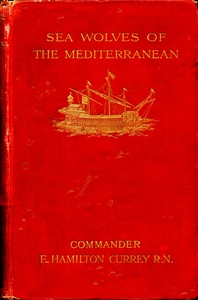
Sea-Wolves of the Mediterranean: The grand period of the Moslem corsairs — Reading Notes
Edition facts
Before opening Sea-Wolves of the Mediterranean: The grand period of the Moslem corsairs — Reading Notes, the edition data offers a quick orientation: 112,469 words, 8 hr 9 min estimated reading time, and 11 detected text sections.
The text analysis averages about 30.7 words per sentence, while the detected sections provide another way to judge how the source is divided.
Project Gutenberg metadata also associates the work with “Pirates,” connecting these edition facts with the source record’s subject description.
Calculated from edition completeness, EPUB availability, text structure and catalogue metadata. Not a user rating.
How this score is calculated
- Description quality20 pts
- Title & short description10 pts
- Source metadata20 pts
- Text length15 pts
- Chapters / structure15 pts
- EPUB file integrity20 pts
Total of 100 points, scaled to a 2.5-5.0 range. Editions with an empty description or a missing EPUB file are not scored.
Read the Text
iod, the stage of world politics was occupied by so many great, striking, and dazzling personalities, that the Sea-wolves and all they accomplished were to a great extent overshadowed by happenings which the chroniclers of the time considered to be of greater importance. In this no doubt they were right in the main; but, in spite of this opinion which they held, we find that time and again the main stream of events is ruffled by the prows of the pirate galleys. Such men as the Barbarossas, as Dragut, and Ali Basha could only have been suppressed and exterminated had the whole might of Christendom been turned against them, for they held in their hands two weapons, the keenest and most powerful with which to attain the objects which they had in view.
The first and more powerful of these was the appeal in a rough and warlike age to the cupidity of mankind. “Those who are content to follow us,” they said in effect, “are certain to enrich themselves if they are men stout of heart and strong of hand. All around us lie rich and prosperous lands; we have but to organise ourselves, and to take anything that we wish for; we can, if we like, gather a rich harvest at comparatively small trouble.” Such counsels as these did not fall on deaf ears. Driven from the land of plenty—from glorious Andalusia with its fruitful soil, its magnificent cities, its vines and olives, its fruit and grain, its noble rivers and wide-spreading _vegas_—the Spanish Moslem of the day of the Sea-wolves was an outcast and a beggar, ripe for adventure and burning for revenge on those by whom he had been expropriated.
Great historians like William Hickling Prescott tell us that, in the course of the seven centuries of the Moslem domination in Spain, the Moors had become soft and effeminate, that “the canker of peace” had sapped, if it had not destroyed, the virile qualities of the race, that luxury and learning had dried up at their source those primitive virtues of courage and hardihood which had been the leading characteristics of those stark fighters who had borne the banner of the Prophet from Mecca even to Cadiz. Tom by faction, by strife among themselves, they had succumbed to the arms of the Northern chivalry; by its warriors they had been driven out, never to return.
When this was accomplished, when the curtain fell on the final scene of the tragedy, and the Moors, after the fall of Granada, were driven across the sea into Africa, there came to pass a most remarkable change in those who had been expropriated. The learning, the culture, the civilisation, by which they had been so long distinguished, seemed to drop away from them, cast away like a worn-out garment for which men have no further use. In place of all these things there came a complete and desperate valour, a bitter and headstrong fanaticism.
It was one of the attributes of the Moslem civilisation in Spain, and one of the most enlightened thereof, that religious toleration flourished in its midst. Jew and Christian were allowed to worship at the altars of their fathers, no man hindering or saying them nay; one rule, and one alone, had to be preserved: none must blaspheme against Mahomet, the Prophet of God, as he was considered to be by the Moslems. The penalty for infraction of this rule was death; otherwise, complete liberty of conscience was accorded.
We have spoken of the two weapons held by the leaders of the Sea-wolves. The first, as we have, said, was cupidity; the second was fanaticism, the deadly religious hatred engendered, not only by the wholesale expropriation of the Moslem population, but also by the persecution to which the Moriscoes—as those Moslems were known who remained in Spain—were subjected by their Christian masters. It requires little imagination to see how these two weapons of avarice and intolerance could be made to serve the purpose of those dominant spirits who rose to the summit of the piratical hierarchy. Not only did they dazzle the imaginations of those who followed in their train by promises of wealth uncounted, but they added to this the specious argument that, in slaying and robbing the Christian wheresoever he was to be found, the faithful Moslem was performing the service of God and the act most grateful to his holy Prophet.
Could any rule of life be at the same time more simple and more attractive to the beggared Mohammedan cast on the sterile shores of Northern Africa to starve?
Currey opens his preface with an extended metaphor comparing a book's launch to a ship's, a figure that recurs throughout the text. This naval framing establishes the author's perspective as a former Royal Navy commander, lending authority to his descriptions of seamanship and battle tactics. The metaphor also signals a deliberate narrative strategy: the book is presented as a vessel whose success depends on 'interest'—a quality Currey claims for his subject, the Moslem corsairs of the sixteenth century.
Naval Metaphor and Authorial Voice
Currey's prose is steeped in nautical language, even when describing non-maritime matters. The preface's ship-launch analogy is the most explicit, but the habit extends to his characterizations: Barbarossa's subordinates are 'too stupid and too prejudiced to understand' strategic reasoning, and their 'blind valour' is contrasted with the admiral's calculated delays. This vocabulary reinforces Currey's professional credibility while also shaping the reader's perception of the corsairs as skilled seamen, not mere pirates.
The authorial voice is consistently that of a seasoned naval officer assessing historical commanders. He quotes Napoleon—'only numbers can annihilate'—and applies modern strategic principles to sixteenth-century engagements. This analytical tone, however, does not preclude dramatic flair; battle scenes are rendered with vivid detail, such as the Ottoman fleet 'issuing from the Gulf of Arta manoeuvring with precision' and forming a crescent line.
Pacing: From Strategic Pause to Sudden Action
Currey manipulates pace to heighten tension, particularly in the account of the 1538 Battle of Preveza. He dwells on Barbarossa's hesitation—'delayed the issue from the soundest of strategical reasons'—and the mounting frustration of his captains. The narrative slows to a crawl as Doria, the Christian admiral, remains 'undecided' for three hours, hesitating on a lee shore. Then, abruptly, the pace accelerates: 'The die was cast' and the Ottoman fleet moves 'slowly moving seaward' but with 'shouts of joy.'
This rhythm of deliberation followed by swift action mirrors Currey's own method. He builds context through careful exposition—the political pressures on Barbarossa, the composition of the fleet—before releasing the energy of combat. The result is a narrative that feels both authoritative and suspenseful, as if the reader is watching a chess match that suddenly erupts into violence.
Voice and the Corsair as Aristocrat
Currey's language elevates the corsairs beyond common pirates, calling them 'the very aristocrats of the profession.' This framing is evident in his treatment of Barbarossa, whom he portrays as a calculating strategist rather than a mere brute. The admiral's speech to his captains—'I have but one order to give, follow my movements attentively'—is rendered with a dignity that suggests respect.
Yet Currey maintains critical distance. He notes that the corsairs' 'blind valour' could have led to disaster, and he attributes their success partly to 'Allah and his Prophet' being 'unusually favourable.' This balance—admiration for skill without romanticizing violence—characterizes the narrative voice throughout. The author is clearly fascinated by his subjects but never loses sight of their mortality or the moral ambiguities of piracy.
Readers should attend to how Currey's naval background inflects his judgments: he evaluates historical figures by professional standards of seamanship and strategy, not by modern morality. The book's pace—alternating between patient exposition and sudden action—reflects the rhythms of naval warfare itself. Those interested in narrative voice will find a distinctive blend of technical analysis and dramatic storytelling, anchored by a consistent metaphor that never quite lets the reader forget the author's own sea-service.
There’s a strange fondness in watching Currey admire the corsairs’ audacity while keeping his distance, like remembering a storm’s beauty after the damage. That same double feeling—respect for skill, sorrow for cost—lingers in the tangled loyalties of The Thirty Years War — Volume 03 — A Closer Reading, where every victory feels a little hollow, each hero slightly compromised.

There are no reviews for this eBook.
What did you think of this book?
Answer a few questions and save a private reflection on this device.