About 226 minutes
The history of the 1st Batt. Wilts Volunteers, from 1861 to 1885 — Edition Insights
Fantasy Juvenile Worlds
51,904 recorded words. 8 minutes difference from this book's estimate.
View Gutenberg source #70903
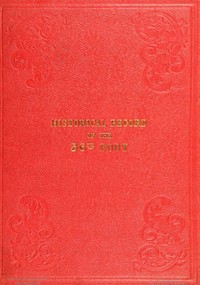
Before opening Historical Record of the Thirty-sixth, or the Herefordshire Regiment of Foot: containing an account of the formation of the regiment in 1701, and of its subsequent — Key Ideas to Explore, the edition data offers a quick orientation: 49,972 words, 3 hr 38 min estimated reading time, and 24 detected text sections.
The text analysis averages about 25.7 words per sentence, while the detected sections provide another way to judge how the source is divided.
Project Gutenberg metadata also associates the work with “Great Britain. Army. Regiment of Foot, 36th -- History,” connecting these edition facts with the source record’s subject description.
Explore this collection
These alternatives are selected using recorded categories and estimated reading time.
About 226 minutes
Fantasy Juvenile Worlds
51,904 recorded words. 8 minutes difference from this book's estimate.
View Gutenberg source #70903About 201 minutes
Fantasy Juvenile Worlds
46,166 recorded words. 17 minutes difference from this book's estimate.
View Gutenberg source #63119About 179 minutes
Fantasy Juvenile Worlds
41,131 recorded words. 39 minutes difference from this book's estimate.
View Gutenberg source #56830Search stored excerpts and compare books → Choose by your preferences →
Choices use stored catalog measurements. Estimates vary with reading speed. A shared category is a catalog label, not a claim that two books have the same argument or literary quality.
Search reads excerpt text stored with this catalog and links to its associated Gutenberg record. The connection is stored in the site database; this tool does not recheck that every excerpt is word-for-word identical to that external record. Excerpt search does not cover every chapter and does not verify historical publication dates.
Catalog snapshot checked: 2026-09-26. Coverage: 90 public books, 90 available source excerpts.
Calculated from edition completeness, EPUB availability, text structure and catalogue metadata. Not a user rating.
Total of 100 points, scaled to a 2.5-5.0 range. Editions with an empty description or a missing EPUB file are not scored.
Public-domain source text
The source text is kept in the dedicated reader, separate from this catalogue record and its commentary.
Richard Cannon's Historical Record of the Thirty-sixth, or the Herefordshire Regiment of Foot opens with a royal command: King William IV ordered that each regiment's services be published under the Adjutant-General's supervision. This directive shapes the entire work, which proceeds as a chronological ledger of the regiment's movements, engagements, and casualties from 1701 to 1852. The prose is deliberately official, favoring precise dates, place names, and administrative details over narrative flourish. Yet within this framework, Cannon occasionally includes striking particulars—such as the tigers that made night travel impossible near Pondicherry—that reveal the human and environmental realities behind the military record.
Cannon's diction is consistently that of a staff officer: he writes of 'completing the establishment,' 'drafting' men, and 'proceeding' to stations. The text is punctuated by reproduced general orders, which lend an air of documentary authority. For instance, the 1836 order specifies that the record must include 'the Period and Circumstances of the Original Formation' and 'the Names of the Officers ... Killed or Wounded.' This bureaucratic voice dominates, but it also defines the regiment's identity through official recognition—such as the 'highly complimentary' orders from Madras in 1798, which are reproduced in the appendix. The reader is thus constantly reminded that the regiment's value is measured by its place in a larger administrative and military hierarchy.
Cannon's battle accounts are terse and factual, often reducing complex actions to a single sentence. The siege of Pondicherry in 1793, for example, is described in a few paragraphs: the army encamped in a wood, tigers menaced the natives, a white flag was displayed, and then French soldiers 'fired two shells, which killed several men.' The narrative does not linger on tactics or emotions; it reports events as they occurred. This restraint can be frustrating for a reader seeking dramatic detail, but it also conveys the regiment's experience as a series of discrete, often mundane tasks—marching, encamping, besieging—interrupted by moments of violence. The record's value lies in its accumulation of such precise, unadorned observations.
Amid the dry chronology, Cannon includes vivid, almost novelistic details. During the Pondicherry siege, he notes that tigers were 'so numerous that the natives durst not travel in the night.' Later, French soldiers 'embraced democratical principles' and became 'particularly insubordinate,' breaking into houses and threatening to hang their governor. The British soldiers then 'rushed into the town, overpowered the insurgents, rescued the Governor, and preserved the inhabitants.' This episode is remarkable for its specificity and drama, standing out against the surrounding lists of stations and drafts. It suggests that Cannon, while bound by official constraints, occasionally allowed himself to record the extraordinary—perhaps because it reflected well on the regiment's discipline and humanity.
The book's structure mirrors the regiment's own rhythm: year by year, station by station. Entries often begin with 'During the year 18XX the regiment was stationed at...' and then note any movements or actions. This repetitive pattern can feel monotonous, but it accurately represents the long periods of garrison duty that characterized much of the regiment's service. The reader experiences the same waiting and routine that the soldiers did. When action occurs—a siege, a march, a draft—it registers as a disruption. Cannon's structure thus becomes a rhetorical device, emphasizing the patience and endurance required of a professional army. The appendix, with its reproduced orders and lists, reinforces this sense of a life governed by paperwork and command.
Cannon's record is best approached as a primary source rather than a narrative history. Readers interested in the texture of military life in the eighteenth and early nineteenth centuries will find value in its precise dates, place names, and occasional vivid details. The work rewards those who read between the lines, noticing what is included—such as the rescue at Pondicherry—and what is omitted, such as the soldiers' own voices. It is a document of institutional memory, shaped by the very bureaucracy it describes.
The way the Herefordshire regiment’s daily records quietly hold the heat of Pondicherry—tigers, mutinies, a rescued governor—reminded me of that long, slow feeling you get when history isn’t about events but about time passing. The Thirty Years War — Volume 03 — A Closer Reading stays with you like that too, a patient weight, the echo of ordinary days inside a larger ruin.
Save your reaction, strongest insight, and memorable passage.