About 166 minutes
The Thirty Years War — Volume 03 — A Closer Reading
Fantasy Juvenile Worlds
38,056 recorded words. 13 minutes difference from this book's estimate.
View Gutenberg source #6772
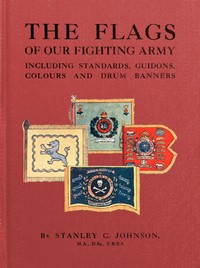
The source record for The Flags of Our Fighting Army Including standards, guidons, colours and drum banners — Context and Discussion measures this digital text at 41,131 words, 2 hr 59 min estimated reading time, and 17 detected text sections.
The text analysis averages about 16.9 words per sentence, while the detected sections provide another way to judge how the source is divided.
Project Gutenberg metadata also associates the work with “Flags -- Great Britain,” connecting these edition facts with the source record’s subject description.
Explore this collection
These alternatives are selected using recorded categories and estimated reading time.
About 166 minutes
Fantasy Juvenile Worlds
38,056 recorded words. 13 minutes difference from this book's estimate.
View Gutenberg source #6772About 201 minutes
Fantasy Juvenile Worlds
46,166 recorded words. 22 minutes difference from this book's estimate.
View Gutenberg source #63119About 154 minutes
Fantasy Juvenile Worlds
35,282 recorded words. 25 minutes difference from this book's estimate.
View Gutenberg source #53308Search stored excerpts and compare books → Choose by your preferences →
Choices use stored catalog measurements. Estimates vary with reading speed. A shared category is a catalog label, not a claim that two books have the same argument or literary quality.
Search reads excerpt text stored with this catalog and links to its associated Gutenberg record. The connection is stored in the site database; this tool does not recheck that every excerpt is word-for-word identical to that external record. Excerpt search does not cover every chapter and does not verify historical publication dates.
Catalog snapshot checked: 2026-09-26. Coverage: 90 public books, 90 available source excerpts.
Calculated from edition completeness, EPUB availability, text structure and catalogue metadata. Not a user rating.
Total of 100 points, scaled to a 2.5-5.0 range. Editions with an empty description or a missing EPUB file are not scored.
Public-domain source text
The source text is kept in the dedicated reader, separate from this catalogue record and its commentary.
The preface to Stanley C. Johnson's The Flags of Our Fighting Army immediately establishes the book's purpose: to fill a gap in accessible literature on British military standards, guidons, and colours. Johnson notes that existing information is 'scattered amongst Regimental histories, biographies of illustrious soldiers, and military periodicals,' making it 'disjointed and difficult of viewing in proper perspective.' This framing positions the work as a synthesis for the general reader, not a specialist monograph. The table of contents reveals a methodical structure, moving from a general history of military colours through chapters on specific branches—Household Cavalry, Dragoon Guards, Foot Guards, Infantry—and concluding with overseas dominions and battle honours. The inclusion of eight colour plates, listed in the front matter, suggests a visual component that complements the textual descriptions.
The preface, dated 1918, acknowledges debts to earlier works such as S. M. Milne's privately printed Standards and Colours of the British Army and to periodical articles in The Regiment. Johnson thanks Lieutenant J. Harold Watkins and Lieutenant C. H. Hastings of the Canadian War Records, hinting at the wartime context of the book's production. The dedication—'To My Brother in the Royal Garrison Artillery. A unit of the Army in which the Guns Serve the Purpose of Regimental Standards'—is a striking personal note that also underscores the symbolic function of flags. This opening material prepares the reader for a work that is both scholarly and patriotic, grounded in existing research but aimed at a broader audience.
The excerpts from the body of the book show a consistent pattern: each regiment is described with its facings (e.g., 'blue' for the King's Own Scottish Borderers), its regimental colour (R.C.) with heraldic devices and mottos, and a list of battle honours. For the Cameronians (Scottish Rifles), Johnson notes simply that 'Rifle regiments do not possess colours'—a factual observation that highlights exceptions. The descriptions are terse and factual, relying on heraldic terminology ('the Castle of Edinburgh,' 'the White Horse,' 'the Sphinx, superscribed “Egypt”'). This uniformity suggests the book functions as a reference work, where readers can quickly compare details across regiments. The battle honours listed—from Namur (1695) to Paardeberg (1900)—span centuries, emphasizing continuity.
A later excerpt provides a dramatic narrative: the story of Lieutenants Melvill and Coghill of the 24th Regiment at Isandlwana in 1879. Johnson quotes a lengthy account of how, after the Zulu attack, Colonel Pulleine ordered Melvill to take the Queen's colour and escape. Both officers died trying to save the flag, and their heroism led to the decision that 'colours should no more be carried into battle.' This is the only extended anecdote in the excerpts, and it serves as a pivotal moment in the book's historical narrative. The account is presented as a quotation, not Johnson's own prose, lending it authority. The detail of the silver wreath presented by Queen Victoria adds a ceremonial coda. This section transforms the book from a dry catalogue into a story of sacrifice and changing military practice.
The table of contents reveals a logical progression: after an introduction and history, the book moves through cavalry, yeomanry, foot guards, infantry, overseas dominions, and miscellaneous colours, ending with battle honours and an appendix on Canadian infantry battalions. This structure allows a reader to dip into a specific chapter or read sequentially. The index (not excerpted) likely aids cross-referencing. The book's 1918 publication date places it during World War I, which may explain the inclusion of Canadian units and the focus on contemporary relevance. For a first-time reader, the preface and the Isandlwana story offer the most engaging entry points, while the regimental descriptions serve as a reliable reference for later consultation.
Johnson's book is best approached as a reference work with a narrative spine. The opening chapters establish context, the middle sections provide systematic data, and the later anecdotes—like the Melvill and Coghill story—offer human drama. Readers interested in heraldry or military history will find the descriptions useful, while those seeking a broader story should start with the preface and the account of the last colours carried into battle. The book's value lies in its synthesis of scattered information into a single, illustrated volume.
I keep thinking about that 1918 flag book, how those colours were the last carried into battle, a quiet weight on someone's shoulder. It made me wonder about the ground beneath those marches, the rivers those soldiers crossed. That's why Pittsbugh's old names, like Fort Duquesne, linger now too, in Fort Duquesne and Fort Pitt; Early Names of Pittsburgh Streets — Key Ideas to Explore, just as softly persistent.
Answer a few questions and save a private reflection on this device.