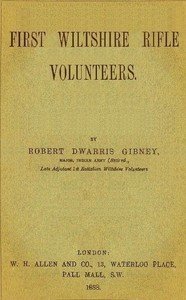
The history of the 1st Batt. Wilts Volunteers, from 1861 to 1885 — Edition Insights
Edition facts
Before opening The history of the 1st Batt. Wilts Volunteers, from 1861 to 1885 — Edition Insights, the edition data offers a quick orientation: 51,904 words, 3 hr 46 min estimated reading time, and 5 detected text sections.
The text analysis averages about 24.6 words per sentence, while the detected sections provide another way to judge how the source is divided.
Project Gutenberg metadata also associates the work with “Great Britain. Army. Wiltshire Regiment. Battalion, 1st -- History,” connecting these edition facts with the source record’s subject description.
Calculated from edition completeness, EPUB availability, text structure and catalogue metadata. Not a user rating.
How this score is calculated
- Description quality20 pts
- Title & short description10 pts
- Source metadata20 pts
- Text length15 pts
- Chapters / structure15 pts
- EPUB file integrity20 pts
Total of 100 points, scaled to a 2.5-5.0 range. Editions with an empty description or a missing EPUB file are not scored.
Read the Text
Wilton were the corps attending from South Wilts, and this they all did in full numbers. Small reviews of this sort, where not only those commanding the whole were regulars, but where regulars took command for the time being of both brigades and battalions, were far more useful, more especially at this early stage of the Volunteer Force, in teaching officers and men what was expected from them, than when the command devolved on the officers of the force--new men, mere learners, if civilians, and if from the line, as a rule but retired captains, or even subalterns, whose knowledge of manœuvring extended not beyond company drill, and yet these were made brigadiers and lieutenant-colonels to command regiments.
There was yet another review of volunteers at which every corps of this battalion was represented, and which came off before the whole were formed into a battalion. The review took place on Durdham Down, near Bristol, and at the time was considered as one of some mark in the volunteer movement. The reviewing officer was Major-General Hutchinson, and in his somewhat laconic address to the troops at the conclusion of the manœuvres, he expressed himself willing to make a favourable report, as the day had been successful. He also observed that he gave them all credit for having taken much pains to become efficient, more especially as he was aware that many had had little battalion drill, and some none at all.
The day was showery, the ground cramped, and spectators here, there and everywhere, and little, if anything, was learned or gained by the volunteers in attendance. But it could not have been otherwise with so few on the staff who knew anything about manœuvring, and some thousands of volunteers commanded by learners only. Here, as elsewhere, beyond the volunteer inspectors, two in number, the staff was composed of young gentlemen from the yeomanry, militia, or line, whose chief recommendation for the appointments of A.D.C., galloper, &c., consisted in their being able to ride fairly well and roar out orders in a loud tone of voice. The object of such orders was no affair of theirs, nor were they supposed to know the correct wording. It was a way we had in the army in those days, and did no great harm as long as playing at soldiers at Brighton, Salisbury, York, &c., was supposed to be lessons in real warfare; but the volunteers were in earnest, and putting away childish things gradually became nearer what soldiers could be; and by pressure on the authorities, and using common sense, helped very much to raise not only themselves to a higher standard of efficiency, but to make the regular army what it is now--a thoroughly useful force, second to none in Europe or elsewhere for scientific and well-taught officers, steady and smart non-commissioned officers, and men who do and know their work.
Major R. D. Gibney, a retired Indian Army officer who served as adjutant to the 1st Wiltshire Volunteers, opens his history by confronting an obvious question: what story can a battalion have that has 'never seen a shot fired in earnest'? His answer is that the very haphazardness of the Volunteer Force—raised in 1859 under threat of invasion, without government support for uniforms, drill sheds, or ammunition—constitutes a history worth recording. The excerpts show a work that oscillates between dry administrative detail and blunt, sometimes sardonic, assessments of the corps' condition.
Improvised Origins and Financial Strain
The preface describes rifle corps being raised 'anywhere, everywhere, anyhow, and nohow' after the government reluctantly permitted volunteer formations in May 1859. Gibney emphasizes that beyond a circular, no assistance was offered: arms, accoutrements, uniforms, drill sheds, practice grounds, and magazines all had to be found by the corps themselves. For country corps, the expense was 'ruinous,' far greater than for companies in large towns where men could drill without losing a day's work or hiring transport. The text notes that arms were eventually furnished by the government after some months, but the initial burden fell entirely on local subscribers and influential patrons.
Drills, Reviews, and the Salisbury Corps
Gibney provides a glimpse of routine through company order books, which monotonously record parades for 'judging distance drill' on Harnham Hill or 'position and aiming drill at the Market House.' The Salisbury Rifle Corps, composed largely of tradesmen, attended reviews at Clarendon Park, Durdham Downs, Bath, Southsea Common, Portsdown, Windsor, and Aldershot. Yet marching-in strength was not well maintained day after day, as tradesmen 'can ill afford to be much away from their work.' The uniform, described as 'more useful than beautiful' and cut after the style of Noah & Sons in the ark, drew mockery from a London street boy who called the officers 'the ugliest buffers we've seen yet.'
Warnings on Readiness and Equipment
In a striking passage, Gibney warns that in a future European war, volunteer battalions made up of 'half-drilled, ignorant bumpkins or mechanics, with no great-coats, paper-soled boots, and underclothing spare and worn' might be summoned by telegraph to repel an invasion. He questions whether such men could be 'weeded out' in time, or whether their 'poor papery boots, spoiled by the mud of the first ditch they are bid to hide in' and their ignorance of signals would lead to disaster. The tone is urgent and critical, suggesting that the author saw the volunteers as a fragile reed, not a reliable defence force.
Gibney's history is neither a dry parade of facts nor a patriotic celebration. It is a candid, occasionally caustic account of how a volunteer battalion was assembled, trained, and equipped under improvisation and financial constraint. Readers interested in Victorian military organisation, local history, or the gap between official policy and on-the-ground reality will find this a valuable primary source—one that speaks as much to the limits of volunteer defence as to its achievements.
Reading about the Wiltshire volunteers, I was struck by how much of their story is makeshift and hopeful, so different from the polished accounts we usually get. It made me think of the corsairs in Sea-Wolves of the Mediterranean: The grand period of the Moslem corsairs — Reading Notes, where the same gap between romantic legend and ragged reality quietly lingers. Both books feel like old friends sharing hard truths.

There are no reviews for this eBook.
How will you remember this book?
Save your reaction, strongest insight, and memorable passage.