About 186 minutes
Historical record of the 71st Regiment Highland Light Infantry — Reading Companion
Adventure Picaresque Fiction
42,774 recorded words. 4 minutes difference from this book's estimate.
View Gutenberg source #70056
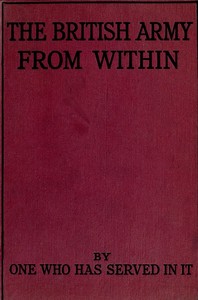
This digital edition of The British Army from Within — Context and Discussion is described by source-level measurements including 41,733 words, 3 hr 2 min estimated reading time, and 14 detected text sections.
The text analysis averages about 36.3 words per sentence, while the detected sections provide another way to judge how the source is divided.
Project Gutenberg metadata also associates the work with “Great Britain. Army,” connecting these edition facts with the source record’s subject description.
Explore this collection
These alternatives are selected using recorded categories and estimated reading time.
About 186 minutes
Adventure Picaresque Fiction
42,774 recorded words. 4 minutes difference from this book's estimate.
View Gutenberg source #70056About 137 minutes
Adventure Picaresque Fiction
31,445 recorded words. 45 minutes difference from this book's estimate.
View Gutenberg source #51376About 134 minutes
Adventure Picaresque Fiction
30,639 recorded words. 48 minutes difference from this book's estimate.
View Gutenberg source #45884Search stored excerpts and compare books → Choose by your preferences →
Choices use stored catalog measurements. Estimates vary with reading speed. A shared category is a catalog label, not a claim that two books have the same argument or literary quality.
Search reads excerpt text stored with this catalog and links to its associated Gutenberg record. The connection is stored in the site database; this tool does not recheck that every excerpt is word-for-word identical to that external record. Excerpt search does not cover every chapter and does not verify historical publication dates.
Catalog snapshot checked: 2026-09-26. Coverage: 90 public books, 90 available source excerpts.
Calculated from edition completeness, EPUB availability, text structure and catalogue metadata. Not a user rating.
Total of 100 points, scaled to a 2.5-5.0 range. Editions with an empty description or a missing EPUB file are not scored.
Public-domain source text
The source text is kept in the dedicated reader, separate from this catalogue record and its commentary.
E. Charles Vivian opens The British Army from Within by claiming the word “Ubique” (Everywhere) for the entire army, not just the Royal Artillery and Engineers. This sets the tone for a work that moves between sweeping generalization and granular detail. Published in 1914, the book captures an army in flux: Vivian notes that the numbers of battalions and regiments from a year ago are “as obsolete as the Snider rifle.” The excerpts reveal a writer who is both insider and critic, praising the soldier’s cosmopolitan opportunities while condemning the “fake and burnish” craze that damages leatherwork. The text is a hybrid of manual, memoir, and polemic, aimed at a civilian readership curious about military life.
Vivian’s opening gambit—extending “Ubique” to the whole army—is immediately qualified by the book’s own structure. The table of contents shows a methodical march through branches: infantry, cavalry, artillery, engineers, camp, musketry. Yet within chapters, the author dwells on exceptions. The Royal Garrison Artillery, he writes, are “the hardest-worked branch of the service” and suffer “worse stations than any other.” They are planted on “lonely coast stations” and “isolated places,” denied the escorts given to field and horse artillery. The Mountain Batteries, immortalized by Kipling, are praised for their niche role on the Indian frontier but admitted to be no match for ordinary field-guns on level ground. Vivian’s “Ubique” thus becomes a claim undercut by his own evidence of uneven distribution of hardship and recognition.
A recurring tension in the excerpts is between genuine efficiency and the performance of order. Vivian criticizes officers who encourage “unnecessary work” under the “fake and burnish” craze, which dries out leather and causes cracking. This is not a minor complaint: it points to a system where inspection rewards appearance over durability. The author contrasts this with the care garrison gunners give their guns, “cared for like babies, nursed and polished.” Yet even that care is part of a cycle of constant learning: the garrison gunner must master “half a hundred patterns” as new guns are handed down from testing grounds. The soldier’s labour is thus divided between genuine maintenance and ritualistic display, a pattern Vivian observes without fully resolving.
Vivian argues that the British soldier has a “chance of seeing the world” unavailable to continental conscripts, becoming “cosmopolitan in his tastes and ways.” But the excerpts also show the cost of that mobility. Garrison gunners are sent to “Aden, the bane of foreign service,” and to “lonely islands in the West Indies, isolated places on the Indian and African coast.” The author’s tone is matter-of-fact, not indignant, but the pattern is clear: the army’s global reach distributes its men unevenly across desirable and punishing posts. The recruit who joins for adventure may find himself in a remote fort with no civilian contact, mastering guns that change with each experiment. Vivian’s insider perspective gives weight to these observations, even as he refrains from outright condemnation.
Readers should approach The British Army from Within as a document of its moment—pre-war, reform-minded, and shaped by the author’s own service. Vivian’s voice is that of a knowledgeable observer who admires the army’s reach but is alert to its internal frictions. The book rewards attention to its specific complaints and asides, which often reveal more than the official descriptions. For those interested in military sociology or Edwardian institutional life, this is a primary source that blends enthusiasm with critical edge.
There’s a particular ache in reading how the 1914 army held its traditions so tightly, knowing the reforms were coming anyway. That tension between what we carry and what we must shed reminds me of those old soldiers who went abroad to fight for other flags. It makes me think of The Cavaliers of Fortune; Or, British Heroes in Foreign Wars — Context and Discussion, and how restlessness always finds its own road home.
Save your reaction, strongest insight, and memorable passage.