About 742 minutes
The Empire of Austria; Its Rise and Present Power — A Reader’s Guide
Adventure Picaresque Fiction
170,607 recorded words. 121 minutes difference from this book's estimate.
View Gutenberg source #16070
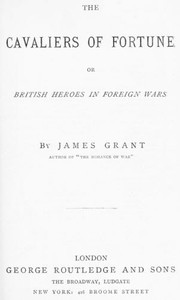
Before opening The Cavaliers of Fortune; Or, British Heroes in Foreign Wars — Context and Discussion, the edition data offers a quick orientation: 142,758 words, 10 hr 21 min estimated reading time, and 13 detected text sections.
The text analysis averages about 32.2 words per sentence, while the detected sections provide another way to judge how the source is divided.
Project Gutenberg metadata also associates the work with “Great Britain -- History, Military,” connecting these edition facts with the source record’s subject description.
Explore this collection
These alternatives are selected using recorded categories and estimated reading time.
About 742 minutes
Adventure Picaresque Fiction
170,607 recorded words. 121 minutes difference from this book's estimate.
View Gutenberg source #16070About 425 minutes
Adventure Picaresque Fiction
97,747 recorded words. 196 minutes difference from this book's estimate.
View Gutenberg source #41244About 421 minutes
Adventure Picaresque Fiction
96,738 recorded words. 200 minutes difference from this book's estimate.
View Gutenberg source #62552Search stored excerpts and compare books → Choose by your preferences →
Choices use stored catalog measurements. Estimates vary with reading speed. A shared category is a catalog label, not a claim that two books have the same argument or literary quality.
Search reads excerpt text stored with this catalog and links to its associated Gutenberg record. The connection is stored in the site database; this tool does not recheck that every excerpt is word-for-word identical to that external record. Excerpt search does not cover every chapter and does not verify historical publication dates.
Catalog snapshot checked: 2026-09-26. Coverage: 90 public books, 90 available source excerpts.
Calculated from edition completeness, EPUB availability, text structure and catalogue metadata. Not a user rating.
Total of 100 points, scaled to a 2.5-5.0 range. Editions with an empty description or a missing EPUB file are not scored.
Public-domain source text
The source text is kept in the dedicated reader, separate from this catalogue record and its commentary.
James Grant opens The Cavaliers of Fortune by positioning his sketches as byproducts of research for his military romances, a framing that signals the blend of archival rigor and narrative flair to follow. The preface immediately establishes a structural pattern: each biography is anchored in specific sources—private letters, War Office records, family papers—yet Grant freely shapes these materials into dramatic episodes. The work's movement across centuries and theaters of war is held together by a recurring image: the soldier who, having little hope of rank at home, sells his sword abroad. This figure appears in the Thirty Years' War, the War of the Spanish Succession, and the Napoleonic campaigns, creating a cumulative portrait of displaced martial ambition.
Grant repeatedly foregrounds his documentary foundations. The memoir of Colonel John Cameron, he notes, was compiled from a mass of private papers and letters submitted by Cameron's brother, Sir Duncan Cameron, as well as from letters by brother officers and the manuscript records of the 92nd Highlanders. This specificity of attribution recurs: the sketch of Count O'Connell draws on information from the War Office and Horse Guards; the account of the Lacys relies on the Biographie Universelle for dates. Grant's method is to weave these sources into a continuous narrative, but he does not erase their traces. The reader is made aware of the archival seams—the letters, the official returns, the family papers—that underwrite each life. This transparency gives the biographies a texture of evidentiary weight, even as Grant's prose moves briskly through battles and court intrigues.
Grant often condenses complex political histories into a single charged encounter. In the account of Marshal Clarke, the Duke of Feltre, the narrative pivots on a dinner-table exchange in 1815. King Frederick William of Prussia reproaches Clarke for the execution of the Burgomaster of Ciritz, calling it 'the useless murder of the father of a family.' Clarke replies, 'It was an unfortunate error.' The king strikes the table: 'An error—it was a crime!' The scene is not merely anecdotal; it crystallizes Grant's interest in the moral ambiguities of command. Clarke, elsewhere praised for his probity and efficiency, is here confronted with the human cost of his obedience. Grant does not resolve the tension—he notes that many accusations against Clarke were 'echoes of complaints raised by the vanquished'—but he lets the dialogue stand as a miniature of the book's larger concern: the gap between official justification and personal responsibility.
Grant structures each biography around a pattern of ascent, crisis, and aftermath. The Clarke sketch, for instance, moves from his appointment as minister of war through the Walcheren expedition and the Mallet conspiracy to the relaxation of his zeal in 1813. The turning point is often a moment of extreme pressure: the Walcheren fever proves 'more deadly to the British troops than the bayonets of France'; Mallet's coup places Paris in the hands of an armed mob for hours. Grant lingers on these crises, detailing the confusion, the narrow escapes, the swift executions. Then he pivots to the aftermath—Clarke's report to Napoleon, his continued service, the gradual waning of his energy. This rhythm gives each life a narrative arc that feels both individual and representative, as if each soldier's career recapitulates the larger fortunes of the causes he served.
Grant closes his preface with a stanza from a song of the Irish Brigade: 'They who survived fought and drank as of yore, / But the land of their heart's hope they never saw more; / For on far foreign fields, from Dunkirk to Belgrade, / Lie the soldiers and chiefs of the Irish Brigade!' The verse functions as a thematic anchor, linking the book's geographical sweep—from Dunkirk to Belgrade—to the emotional cost of exile. Grant notes that the Irish troops in French service 'filled Europe with the fame of their exploits,' but the song's refrain emphasizes loss rather than glory. Throughout the biographies, this tension between martial achievement and personal displacement recurs. The soldiers are defined by their effectiveness in foreign wars, yet their stories are shadowed by the homeland they cannot return to. Grant's own position is ambivalent: he celebrates their valor while acknowledging the conditions—'having nothing better to do at home'—that drove them abroad.
Grant's method rewards readers who attend to the interplay between his documentary sources and his narrative shaping. The private letters, official records, and family papers he cites are not mere ornaments; they are the scaffolding on which each biography is built. Yet the final effect is not antiquarian but dramatic—a series of scenes in which individual choices collide with historical forces. Readers may find it useful to note where Grant quotes directly from his sources and where he summarizes, as this distinction often marks the boundary between evidence and interpretation. The book's structure, moving from one life to the next across centuries and countries, invites comparison between figures who never met but who shared the condition of the soldier of fortune.
There’s something in Grant’s old soldiers—fighting for causes not quite their own—that makes me think of that other distant, dutiful journey, the Atlantic Fleet’s long peacetime cruise. It was service as much as spectacle. I found myself lingering on that contrast while reading With the Battle Fleet Cruise of the Sixteen Battleships of the United States Atlantic Fleet from Hampton Roads to the Golden Gate, December, 1907-May, 1908 — Reading Companion. Different uniforms, same strange homesickness.
Your answers remain private and are stored only in this browser.