About 48 minutes
History of the United Netherlands, 1588c — A Reader’s Guide
Adventure Picaresque Fiction
11,010 recorded words. 5 minutes difference from this book's estimate.
View Gutenberg source #4857
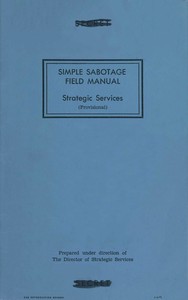
Before opening Simple Sabotage Field Manual — Key Ideas to Explore, the edition data offers a quick orientation: 12,066 words, 53 min estimated reading time, and 6 detected text sections.
The text analysis averages about 20.2 words per sentence, while the detected sections provide another way to judge how the source is divided.
Project Gutenberg metadata also associates the work with “Sabotage,” connecting these edition facts with the source record’s subject description.
Explore this collection
These alternatives are selected using recorded categories and estimated reading time.
About 48 minutes
Adventure Picaresque Fiction
11,010 recorded words. 5 minutes difference from this book's estimate.
View Gutenberg source #4857About 40 minutes
Adventure Picaresque Fiction
9,120 recorded words. 13 minutes difference from this book's estimate.
View Gutenberg source #31319About 21 minutes
Adventure Picaresque Fiction
4,713 recorded words. 32 minutes difference from this book's estimate.
View Gutenberg source #49968Search stored excerpts and compare books → Choose by your preferences →
Choices use stored catalog measurements. Estimates vary with reading speed. A shared category is a catalog label, not a claim that two books have the same argument or literary quality.
Search reads excerpt text stored with this catalog and links to its associated Gutenberg record. The connection is stored in the site database; this tool does not recheck that every excerpt is word-for-word identical to that external record. Excerpt search does not cover every chapter and does not verify historical publication dates.
Catalog snapshot checked: 2026-09-26. Coverage: 90 public books, 90 available source excerpts.
Calculated from edition completeness, EPUB availability, text structure and catalogue metadata. Not a user rating.
Total of 100 points, scaled to a 2.5-5.0 range. Editions with an empty description or a missing EPUB file are not scored.
Public-domain source text
The source text is kept in the dedicated reader, separate from this catalogue record and its commentary.
The Simple Sabotage Field Manual, issued by the Office of Strategic Services in January 1944, treats sabotage not as a specialist's domain but as a civic duty open to any householder. Its opening pages define two parallel tracks: one relying on everyday materials—salt, nails, candles—and another on what it calls the “human element,” where faulty decisions and a noncooperative attitude become weapons. The manual’s tone is brisk and procedural, yet its examples reveal a peculiar intimacy with domestic and workplace routines, from the kitchen shelf to the railway switchboard.
The manual explicitly distinguishes between physical destruction and psychological obstruction. For the former, it lists “salt, nails, candles, pebbles, thread” as legitimate tools—items a citizen might “normally be expected to possess.” The latter requires no tools at all: “making a faulty decision may be simply a matter of placing tools in one spot instead of another.” This duality recurs throughout. In transportation, for instance, the saboteur can either spread salt on electrical switch points (short-circuiting them when it rains) or simply “make mistakes in issuing train tickets.” The manual frames both as equally valid, and it repeatedly stresses that the second type—bickering, surliness, deliberate stupidity—is “frequently responsible for accidents, delays, and general obstruction even under normal conditions.”
The manual’s most detailed instructions concern railways. It advises attendants to “take up tickets after midnight, call all station stops very loudly during the night, handle baggage as noisily as possible.” Engineers should “run trains slow or make unscheduled stops for plausible reasons.” The cumulative effect is a portrait of sabotage as a series of petty annoyances: misrouted luggage, switched address labels, loosened couplings. On roads, the manual recommends changing signposts at intersections and removing danger signals from curves. These acts require no explosives or specialized knowledge—only a willingness to exploit routine access. The manual’s phrasing—“see that cars are put on the wrong trains,” “see that the food is especially bad”—casts the saboteur as a quiet orchestrator of inconvenience.
A brief section on agriculture notes that crops and livestock “probably will be destroyed only in areas where there are large food surpluses or where the enemy (regime) is known to be requisitioning food.” The manual suggests feeding crops to livestock, letting harvests spoil by soaking grain in water, or leaving fruit and vegetables in the sun. These instructions are terse, almost afterthoughts, but they reveal a strategic calculus: sabotage is not indiscriminate but targeted where it will strain supply lines. The parenthetical “(regime)” hints at the manual’s intended audience—occupied populations—and the assumption that even small acts of spoilage can accumulate into meaningful disruption when multiplied across many citizens.
Readers should note that the manual is a period document, shaped by the specific conditions of World War II and the OSS’s need to train resistance networks. Its recommendations are not a blueprint for modern action but a historical artifact of how state actors once imagined civilian participation in conflict. The emphasis on everyday materials and minor frictions offers a counterpoint to high-tech warfare, revealing a belief that ordinary people, armed only with household items and a stubborn attitude, could erode an enemy’s efficiency from within.
That old manual made me think about how ordinary people quietly shape history, not through grand acts but through small, stubborn choices. It reminded me of those earnest notes on the History of the United Netherlands, 1586c — Reading Notes. There’s something tender in watching people just keep going, day after day, even when the outcome feels far away. That feeling stays with me.
Save your reaction, strongest insight, and memorable passage.