Terrain Exercises — Inside the Classic

(0 User reviews)   316
Waldron, William H. (William Henry), 1877-1947 Project Gutenberg 2020 Not confirmed
Tactics Readers of public-domain and historical texts
Project Gutenberg digital edition en

Edition facts

Words 96,738
Reading time 421 min
Text sections 22

Terrain Exercises — Inside the Classic can be approached with a clearer sense of reading commitment from its source measurements: 96,738 words, 7 hr 1 min estimated reading time, and 22 detected text sections.

The text analysis averages about 15.5 words per sentence, while the detected sections provide another way to judge how the source is divided.

Project Gutenberg metadata also associates the work with “Tactics,” connecting these edition facts with the source record’s subject description.

A 1923 U.S. Army manual presenting nine terrain exercises for training officers and NCOs in tactical decision-making, using hypothetical scenarios on actual ground to bridge classroom theory and field practice.
Share
Editorial Edition Score 4.9/5

Calculated from edition completeness, EPUB availability, text structure and catalogue metadata. Not a user rating.

How this score is calculated
  • Description quality20 pts
  • Title & short description10 pts
  • Source metadata20 pts
  • Text length15 pts
  • Chapters / structure15 pts
  • EPUB file integrity20 pts

Total of 100 points, scaled to a 2.5-5.0 range. Editions with an empty description or a missing EPUB file are not scored.

Edition quality

Read the Text

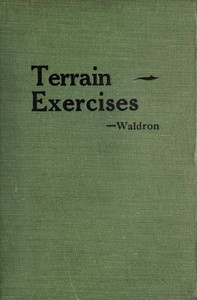
Lt. Col. William H. Waldron Infantry, U. S. Army

Washington United States Infantry Association 1923

Copyright, 1923 By United States Infantry Association

HAYWORTH PUBLISHING HOUSE, WASHINGTON, D. C.

TERRAIN EXERCISE NO. 1

Attack of Strong Point—Rifle Company 11

TERRAIN EXERCISE NO. 2

Approach March and Deployment 51

TERRAIN EXERCISE NO. 3

Defensive Position 107

TERRAIN EXERCISE NO. 4

A Machine Gun Company in Attack 141

TERRAIN EXERCISE NO. 5

TERRAIN EXERCISE NO. 6

TERRAIN EXERCISE NO. 7

Posting an Outpost 255

TERRAIN EXERCISE NO. 8

A Visiting Patrol 299

TERRAIN EXERCISE NO. 9

A Reconnoitering Patrol 337

Terrain Exercises are those military exercises in which the students carry on the operations of imaginary bodies of troops over the actual terrain. As these exercises involve the study of the utilization of the ground itself and the application of tactical formations and methods to it, they are the best means, aside from practical field work with troops, of giving officers and non-commissioned officers practice in carrying out the duties that fall to them in war.

In the Terrain Exercise is found the logical step in tactical training, between the theory and practice of the classroom and the practical training with troops. This method of training is suited to all arms and services, and in view of its practical value is constantly employed by unit commanders in the training of their officers and non-commissioned officers.

Any class of military operations may be practiced, such as the operations of covering troops—advance guards, flank guards and outposts; the operations of the various kinds of patrols; combat—attack and defense; approach march and deployment, and the tactical cooperation of all special arms.

The smooth working and success of the Terrain Exercise depends almost entirely on the ability and tactical knowledge of the Director, the care he devotes to the selection of the ground, the preparation of the problem, and his own personal preparation for the conduct of the Terrain Exercise. To this end a study should be made of the tactical training it is desired to impart. A problem designed to bring out these points should be drawn up and fitted to the ground. The successive special situations must follow in logical sequence.

The Director must have in his mind a solution of the various situations of the problem and must familiarize himself with all of its phases to the extent that he will be able to make reasonable answer to any question that may be propounded.

He must receive all the ideas presented by the members of the class; take out the good and tactfully discard the poor and indifferent. He must take care that he does not unduly criticize the members of the class when they make mistakes and faulty dispositions. Above all, he must never hold up a solution to ridicule.

Preparation of the Problem

Having determined upon the tactical subject to be studied, the next essential is a problem, clearly and tersely stated, logically drawn and easily understood. The several tactical situations should follow one another in their natural sequence. Each should bring out the tactical points that it is desired to impress upon the members of the class. Long and complex situations, difficult for the average man to grasp, should be avoided. Situations should be interesting and instructive, natural and simple.

The next step is to fit the problem to a particular section of the terrain that may be available. In this connection it is well to draw up a tentative problem with its several situations. Then go out on the ground and fit the problem to it.

The Director should carefully work out on the ground beforehand the several situations that he desires to develop. He should work out the details of all possible solutions and prepare himself to discuss the advantages and disadvantages of measures that may be proposed by members of the class and to state the solution that he, himself, prefers, with the reasons therefor.

A sufficient number of copies of the initial problem, together with the special situations, should be prepared so that a copy may be available for each member of the class. This is a more satisfactory method than the Director explaining them verbally. Time is saved and misunderstandings avoided. The special situations are numbered serially and issued at the proper time, as the Exercise progresses. It is a good idea to have an envelope in which to carry the cards or slips of paper bearing each special situation.

General Conduct of a Terrain Exercise

The problem will ordinarily consist of a general situation and several situations.

Lt. Col. William H. Waldron’s Terrain Exercises (1923) is a tactical training manual built around nine scripted problems, each staged on real ground rather than a map. The book’s structure is procedural: a Director issues numbered situations, participants propose solutions, and the Director provides a keyed explanation. The excerpts show that the exercises are not free-form simulations but tightly controlled drills—the Director must have a predetermined solution in mind and must be prepared to answer any question. The manual’s stated purpose is to give officers and non-commissioned officers practice in the duties of war, yet the text itself is a script for the instructor, not a narrative for the student.

The Director as Author and Arbiter

The manual assigns the Director an outsized role. The introduction states that success depends almost entirely on the Director’s ability, tactical knowledge, and personal preparation. In the excerpts, the Director does not merely facilitate—he judges. When Lieutenant Ralston argues that flank patrols are unnecessary, the Director responds with a pointed explanation: “Never send out a flank patrol unless there is some sound tactical reason for it.” The Director then collects sketches, redistributes them to different students, and invites criticism. This structure makes the Director the sole authority on tactical correctness, turning each exercise into a demonstration of his own doctrine rather than an open exploration of alternatives.

Scripted Problems, Not Free Play

Each exercise follows a rigid sequence. The Director hands out a printed situation slip, reads it aloud, and then explains why the class is at that exact location. For example, Advance Guard Card No. 3 instructs the Director to “conduct the class to the place where the situation is to be taken up” and then “explain why Situation is taken up at this point instead of five miles farther on.” The problem is not discovered in the field; it is staged. The students’ task is to respond to a predetermined scenario—enemy movement, terrain features, unit dispositions—and produce a sketch or verbal solution. The manual’s table of contents lists nine exercises, each with a specific tactical focus (attack of a strong point, approach march, defensive position, etc.), reinforcing that the book is a curriculum, not a simulation engine.

The Gap Between Subject and Practice

The catalog subject for this record is “Tactics,” and the manual indeed teaches tactical principles. But the excerpts reveal that the book’s primary content is not tactical theory but classroom management. The introduction defines terrain exercises as “the logical step in tactical training, between the theory and practice of the classroom and the practical training with troops.” Yet the text itself is a guide for running those exercises—it tells the Director when to hand out cards, how long to allow for sketches (10–15 minutes), and how to collect and redistribute them. The actual tactical content is embedded in the situations and Director’s keys, which are only partially reproduced in the excerpts. A reader expecting a treatise on tactics will instead find a manual for conducting a specific training method.

Terrain Exercises is best approached as a period artifact of U.S. Army interwar training doctrine. Its value lies not in the tactical solutions it prescribes—many of which are now dated—but in the pedagogical structure it codifies. Readers interested in the history of military education will find a clear example of how the army sought to standardize tactical thinking through scripted field problems. Those seeking combat narratives or modern doctrine should look elsewhere.

There’s something humbling in that 1923 manual’s quiet assumption that ground itself teaches, if you’ll only look. It reminds me of another old friend, the way The war myth in United States history — A Closer Reading lingers on what we choose to see in a landscape of memory. Both feel like conversations left half-open, waiting for a patient reader’s return.

There are no reviews for this eBook.

0
0 out of 5 (0 User reviews )

Add a Review

Your Rating *
There are no comments for this eBook.

Reader reflection

Your personal reading reflection

Build a private reading journal entry for this title.

Your progress 0 / 10
1

What is your current status with this title?

2

What was your overall reaction to the book?

3

Is this a title you would suggest to others?

4

Did the language feel accessible?

Related eBooks