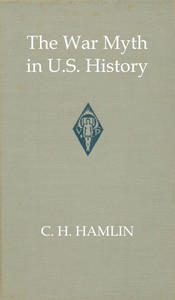
The war myth in United States history — A Closer Reading

(0 User reviews)   69
Hamlin, C. H. (Charles Hunter), 1890-1985, Dole, Charles F. (Charles Fletcher), 1845-1927 [Author of introduction, etc.] Project Gutenberg 2024 Not confirmed
United States -- History; War; Propaganda, American Readers of public-domain and historical texts
Project Gutenberg digital edition en

Edition facts

Words 23,113
Reading time 101 min
Text sections 3

This digital edition of The war myth in United States history — A Closer Reading is described by source-level measurements including 23,113 words, 1 hr 41 min estimated reading time, and 3 detected text sections.

The text analysis averages about 19.2 words per sentence, while the detected sections provide another way to judge how the source is divided.

Project Gutenberg metadata also associates the work with “United States -- History,” connecting these edition facts with the source record’s subject description.

A 1927 revisionist history that systematically challenges the necessity and morality of each major U.S. war, from the Revolution to World War I, arguing they were driven by propaganda and elite interests rather than noble causes.
Share
Editorial Edition Score 4.5/5

Calculated from edition completeness, EPUB availability, text structure and catalogue metadata. Not a user rating.

How this score is calculated
  • Description quality20 pts
  • Title & short description10 pts
  • Source metadata20 pts
  • Text length15 pts
  • Chapters / structure15 pts
  • EPUB file integrity20 pts

Total of 100 points, scaled to a 2.5-5.0 range. Editions with an empty description or a missing EPUB file are not scored.

Edition quality

Read the Text

Britain was forced to repeal the tariff on imports in 1770. The amount of imported goods in the New England colonies alone dropped from 1,363,000 pounds in 1768 to 504,000 pounds in 1769. After the repeal in 1770 the imports in 1771 were doubled. Thus the boycott was a powerful weapon in the hands of the colonies. With it the colonies were in a position to enforce almost any demand they liked upon Great Britain.

(7) When the Townshend duties were repealed in 1770 a tax was still left on tea, in order to assert the right to levy such a tax. In 1773, Great Britain allowed a tea company known as the East India Company to bring over a large quantity of tea. This company had been given a monopoly of the colonial tea market. When this tea arrived in Boston, on December 16, 1773, a group of men entered the ship and threw overboard the cargo valued at about £15,000. But why was this tea destroyed? Simply because the leaders in this act were tea merchants in Boston, whose trade would have to compete with the newly arrived tea had it been permitted to enter the market. The act was the destruction of private property on the part of the participants. The more moderate element in Boston wanted the tea paid for and the action repudiated.

(8) As a punishment for this performance, Great Britain passed the five punitive or coercive acts of 1774. These five acts were the following: Close the port of Boston until the tea should be paid for. Revise the charter of Massachusetts. Send to England for trial colonial agents accused of violence in the execution of their duties. Station soldiers in Massachusetts to aid in the execution of law. Annex to Quebec the land between the Ohio River and the Great Lakes. These acts were all legal. Great Britain had as much right to demand that Boston pay for the tea destroyed as we have to demand that a foreign power compensate our subjects for property lost there through the mob action of its subjects.

(9) Another cause of the Revolution often overlooked was the general economic depression both in Great Britain and the colonies following the close of the French and Indian War in 1763. This was felt in all industries. Depressions of this sort always create political unrest and a desire for change in government, even though the authorities in power are in no way responsible for the condition. This is especially true in American political history. Presidential elections have been determined by economic conditions having no direct bearing upon the issues involved.

(10) The tenth and last cause we shall give of the American Revolution was the religious cause. There was a movement on foot to locate an Episcopal bishop in the colonies. At that time all the clergy of the Episcopal Church were ordained in England as there was no bishop here. Consequently, all the Episcopal ministers came from abroad and they were often mediocre, for the more efficient among them were kept in England. In 1770 there were about two hundred and fifty Episcopal clergy in the colonies, most of whom were in Virginia. The rumor of locating a bishop here aroused resentment in the other denominations who unanimously opposed the plan. But the most effective religious cause of the Revolution came from still another source. When Great Britain extended Quebec down between the Ohio River and the Great Lakes, the Catholic Church was made the established church of these regions, as it was in Quebec. This greatly incensed all Protestants and "no pope no king" became one of the slogans of the Revolution. John Adams considered this religious animosity "as much as any other a cause" of the war for independence. Both these attitudes on the part of the colonies were unwise. An Episcopal bishop was badly needed here to elevate the Episcopal clergy and remove the unworthy ministers. The prejudice against Catholics was simply folly. The Catholic priests in the colonies unanimously supported the Revolution.

Hamlin’s study opens with a blunt premise: the time has come to ask “soberly” whether every war the United States has fought “had to be, and if it had to be, why?” The introduction, by Charles F. Dole, sets the tone by grouping war with “old world evils, like slavery or witchcraft” that humanity should clear away. The book then moves chronologically through six conflicts, from the Revolutionary War to the World War, applying a consistent lens: each war is examined for its stated causes, the economic and political pressures behind it, and the gap between official rhetoric and historical evidence.

A Recurring Pattern of Abstraction

Across the excerpts, Hamlin identifies a repeated mechanism: wars arise not from clear threats but from abstract principles. The Civil War, he argues, was fought over “the status of slavery in the western territory”—an abstraction—with both sides claiming to defend the Constitution. He notes that Lincoln’s election defied the Dred Scott decision, and that the lower south seceded as “a gesture to uphold the courts and the Constitution.” The result was a conflict where “neither section understood the other” and “emotionalism” overwhelmed reason. This pattern of abstraction recurs: the War of 1812, the Mexican War, and the Spanish-American War are each presented as contests over legal or ideological claims rather than tangible national interests.

Numbers as Counter-Narrative

Hamlin frequently deploys statistics to undermine heroic narratives. In the Civil War section, he cites voting data to show that Lincoln received only 26,430 votes in the entire South, while the moderate Douglas and Unionist Bell together outpolled the pro-slavery Breckenridge. “A majority in the south opposed secession,” he writes, “but the southern states fell into the hands of the secessionists by a plurality.” He also tracks slavery’s decline: in Missouri, the slave population fell from 17.8% of the total in 1830 to 9.8% in 1860, and Kansas voted 11,300 to 1,788 against slavery in 1858. These figures are used to argue that slavery was “dying” and that war was not necessary to end it.

The Structure of a Systematic Reassessment

The book’s architecture is straightforward: an introduction by Dole, followed by seven chapters—one for each major war, plus an opening chapter on “Patriotism and Peace.” Each chapter appears to follow a similar method: state the conventional justification, then present evidence of economic motives, political maneuvering, and propaganda. The introduction frames the project as a “rapid survey and analysis” that “boldly carries over all the wars of our own United States into the broad generalization which includes the wars of other nations.” This structural repetition reinforces the argument that no American war was exceptional; all belong to the same category of preventable catastrophe.

Movement Between Scales

Hamlin moves fluidly between broad historical claims and specific, localized details. He cites Lloyd George’s remark that nations “staggered and stumbled” into World War I, then pivots to the precise number of slaves in New Mexico (twenty-two at one time). He contrasts the global abolition of slavery—Britain in 1833, Mexico in 1827, Brazil in 1888—with the American Civil War, noting that elsewhere abolition occurred “without conflict.” This technique of juxtaposing macro and micro evidence serves to isolate the American case as an outlier, suggesting that war was not an inevitable outcome of slavery but a choice shaped by political failure and inflamed public sentiment.

Readers should approach this book as a polemic grounded in historical data, not a neutral survey. Hamlin’s evidence is selective—he emphasizes economic and political factors while giving less weight to moral or humanitarian motives—but his method is transparent. The value lies in watching a coherent argument unfold across six case studies, each challenging a cherished national story. For those interested in the mechanics of war propaganda or the historiography of American exceptionalism, this remains a provocative document from the interwar peace movement.

I’ve often found that books whisper to one another across the decades. This old 1927 history, stripping away our wartime mythologies, feels like a skeptical, windswept sentinel—not unlike the quiet fortifications chronicled in English Coast Defences From Roman Times to the Early Years of the Nineteenth Century — Reading Companion. Both, in their way, simply ask what stone and steel were truly guarding.

There are no reviews for this eBook.

0
0 out of 5 (0 User reviews )

Add a Review

Your Rating *
There are no comments for this eBook.

Reader reflection

Your personal reading reflection

Build a private reading journal entry for this title.

Your progress 0 / 10
1

Where are you in your reading?

2

How did the book work for you overall?

3

Would you pass this book on to a friend?

4

Did the language feel accessible?

Related eBooks