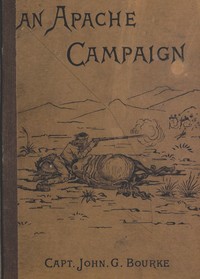
An Apache Campaign in the Sierra Madre An Account of the Expedition in Pursuit of the Hostile Chiricahua Apaches in the Spring of 1883 — Text and Context

(0 User reviews)   49
Bourke, John Gregory, 1846-1896 Project Gutenberg 2021 Not confirmed
Apache Indians -- Wars, 1883-1886; Chiricahua Indians -- Wars Readers of public-domain and historical texts
Project Gutenberg digital edition en

Edition facts

Words 24,536
Reading time 107 min
Text sections 9

The catalog record for An Apache Campaign in the Sierra Madre An Account of the Expedition in Pursuit of the Hostile Chiricahua Apaches in the Spring of 1883 — Text and Context provides practical reading context through 24,536 words, 1 hr 47 min estimated reading time, and 9 detected text sections.

The text analysis averages about 25.6 words per sentence, while the detected sections provide another way to judge how the source is divided.

Project Gutenberg metadata also associates the work with “Apache Indians -- Wars, 1883-1886,” connecting these edition facts with the source record’s subject description.

John G. Bourke's 1883 account of General Crook's expedition into the Sierra Madre, structured around the movement of troops through treacherous terrain and the observation of abandoned Apache strongholds, with attention to the material culture and predictive rituals of the Chiricahua.
Share
Editorial Edition Score 4.7/5

Calculated from edition completeness, EPUB availability, text structure and catalogue metadata. Not a user rating.

How this score is calculated
  • Description quality20 pts
  • Title & short description10 pts
  • Source metadata20 pts
  • Text length15 pts
  • Chapters / structure15 pts
  • EPUB file integrity20 pts

Total of 100 points, scaled to a 2.5-5.0 range. Editions with an empty description or a missing EPUB file are not scored.

Edition quality

Read the Text

rms and corselet of steel he was unable to push back this fierce, astute aborigine, provided simply with lance and bow. The past fifty years have seen the Apache provided with arms of precision, and, especially since the introduction of magazine breech-loaders, the Mexican has not only ceased to be an intruder upon the Apache, but has trembled for the security of life and property in the squalid hamlets of the States of Chihuahua and Sonora.

In 1871 the War Department confided to General George Crook the task of whipping into submission all the bands of the Apache nation living in Arizona. How thoroughly that duty was accomplished is now a matter of history. But at the last moment one band--the Chiricahuas--was especially exempted from Crook’s jurisdiction. They were not attacked by troops, and for years led a Jack-in-the-box sort of an existence, now popping into an agency and now popping out, anxious, if their own story is to be credited, to live at peace with the whites, but unable to do so from lack of nourishment.

When they went upon the reservation, rations in abundance were promised for themselves and families. A difference of opinion soon arose with the agent as to what constituted a ration, the wicked Indians laboring under the delusion that it was enough food to keep the recipient from starving to death, and objecting to an issue of supplies based upon the principle according to which grumbling Jack-tars used to say that prize-money was formerly apportioned,--that is, by being thrown through the rungs of a ladder--what stuck being the share of the Indian, and what fell to the ground being the share of the agent. To the credit of the agent it must be said that he made a praiseworthy but ineffectual effort to alleviate the pangs of hunger by a liberal distribution of hymn-books among his wards. The perverse Chiricahuas, not being able to digest works of that nature, and unwilling to acknowledge the correctness of the agent’s arithmetic, made up their minds to sally out from San Carlos and take refuge in the more hospitable wilderness of the Sierra Madre. Their discontent was not allayed by rumors whispered about of the intention of the agent to have the whole tribe removed bodily to the Indian Territory. Coal had been discovered on the reservation, and speculators clamored that the land involved be thrown open for development, regardless of the rights of the Indians. But, so the story goes, matters suddenly reached a focus when the agent one day sent his chief of police to arrest a Chiricahua charged with some offense deemed worthy of punishment in the guard-house. The offender started to run through the Indian camp, and the chief of police fired at him, but missed his aim and killed a luckless old squaw, who happened in range. This wretched marksmanship was resented by the Chiricahuas, who refused to be comforted by the profuse apologies tendered for the accident. They silently made their preparations, waiting long enough to catch the chief of police, kill him, cut off his head, and play a game of foot-ball with it; and then, like a flock of quail, the whole band, men, women, and children--710 in all--started on the dead run for the Mexican boundary, one hundred and fifty miles to the south.

Hotly pursued by the troops, they fought their way across Southern Arizona and New Mexico, their route marked by blood and devastation. The valleys of the Santa Cruz and San Pedro witnessed a repetition of the once familiar scenes of farmers tilling their fields with rifles and shot-guns strapped to the plow-handle. While engaged in fighting off the American forces, which pressed too closely upon their rear, the Apaches were attacked in front by the Mexican column under Colonel Garcia, who, in a savagely contested fight, achieved a “substantial victory,” killing eighty-five and capturing thirty, eleven of which total of one hundred and fifteen were men, and the rest women and children. The Chiricahuas claim that when the main body of their warriors reached the scene of the engagement the Mexicans evinced no anxiety to come out from the rifle-pits they hastily dug. To this fact no allusion can be found in the Mexican commander’s published dispatches.

Bourke’s narrative moves with the column, tracking the physical strain of crossing steep ridges and narrow gorges. The account is built around the sequence of the march: each day brings a new ridge, a new trail, and a new set of abandoned camps. The reader is placed alongside the pack-trains, watching mules fall over precipices and noting the carcasses of animals that line the path. This is not a retrospective overview but a day-by-day record of movement through a landscape that resists passage.

The excerpts reveal a text attentive to the signs left behind by the Chiricahua. Bourke describes the arrangement of huts, the scattered bones of cattle, and the implements of daily life—hair-brushes of grass, a child’s sliding rocks, the tools of a young man’s coming-of-age. These details are not embellished; they are presented as evidence of a recent presence, read by the scouts who interpret the ground.

The Rhythm of the March

The expedition’s progress is marked by a repeated pattern: climb, cross, descend. Bourke records the condition of the trail, the loss of animals, and the changing character of the terrain. On May 9, five mules fell over a precipice; three broke their necks, two had to be shot. Such losses are noted without dramatization, as part of the cost of moving through the Sierra Madre. The narrative does not pause for reflection but continues to the next ridge, the next gorge.

This structure gives the account a cumulative weight. The reader experiences the expedition as a series of obstacles overcome, not as a single dramatic event. The pack-trains struggle to keep the trail; ax-men clear obstructions; scouts fan out to read the ground. Bourke’s prose mirrors the labor of the march—steady, repetitive, and focused on the immediate task.

Reading the Abandoned Stronghold

When the column reaches the Chiricahua stronghold, Bourke describes it as an amphitheatre, a natural bowl with a stream, pine, oak, and cedar. The site is empty, but its features are catalogued: the pinnacles where pickets were posted, the scattered huts, the heads and bones of cows and ponies. The absence of mescal suggests meat was the principal food. The scouts point out where a mother cut a child’s hair, where youngsters slid down rocks.

These observations are forensic. Bourke does not speculate on the emotions of the departed inhabitants; he records what the ground reveals. The stronghold is evaluated for its defensive qualities—water, cover, visibility—and for the duration of its occupation. The narrative treats the site as evidence of a way of life, not as a setting for action.

Prophecy and the Ritual of Pursuit

Before the march, Bourke witnesses a ceremony among the Apache scouts. One man lies in a trance, thumping his chest and pointing to the east and north, muttering predictions: “Me catch ’um, me kill ’um. Me no catch ’um, me no kill ’um.” The prophecies are translated by an old friend in the circle. The scouts listen with rapt attention.

This episode interrupts the narrative of movement with a moment of stillness. The ritual is described in detail—the low chant, the trance, the specific language of the prophecy. Bourke does not dismiss it as superstition; he presents it as a parallel system of knowledge, one that the scouts take seriously. The prophecy’s conditional structure (“mebbe so six day… mebbe so two day”) mirrors the uncertainty of the campaign itself.

Material Culture as Evidence

Throughout the excerpts, Bourke notes the objects left behind by the Chiricahua: a Winchester rifle, bows and arrows, hair-brushes of grass, the implements used by a young man assuming the duties of manhood. He also describes the practice of sucking water through a quill or cane during periods of vow. These details are presented without commentary, as part of the inventory of the abandoned camp.

The effect is ethnographic. Bourke treats the material remains as clues to social practices and individual lives. The rifle and the grass brush coexist in the same paragraph, suggesting a culture that incorporates both traditional and acquired technologies. The narrative does not judge; it records. This attention to the physical traces of the Chiricahua gives the account a texture that goes beyond military report.

Bourke’s account rewards a reader who attends to the ground-level details of the march and the camps. The narrative’s structure—day by day, ridge by ridge—invites the reader to follow the column’s movement and to notice what the scouts notice: the tracks, the abandoned objects, the signs of recent occupation. The excerpts offer a partial view, but they suggest a work that is less about battle than about the labor of pursuit and the evidence of a people who have moved on.

Reading Bourke’s patient, almost tender cataloguing of abandoned Apache lodges, I remembered my own grandfather’s frayed 1905 drill manual, its margins filled with penciled notes about marching cadence. There’s a strange intimacy in studying what someone left behind—ritual gestures, worn equipment, quiet footprints. That old Infantry training, 1905 — Reading Companion gave me the same ache: orders meant to outlast the men who followed them.

There are no reviews for this eBook.

0
0 out of 5 (0 User reviews )

Add a Review

Your Rating *
There are no comments for this eBook.

Reader reflection

How will you remember this book?

Save your reaction, strongest insight, and memorable passage.

Your progress 0 / 10
1

Which reading stage best describes you?

2

What was your overall reaction to the book?

3

Would you recommend this book to another reader?

4

How easy was the book to follow?

Related eBooks