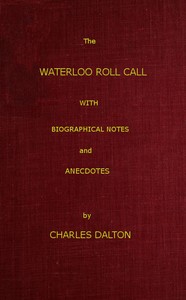
The Waterloo Roll Call With Biographical Notes and Anecdotes — Reading Companion

(0 User reviews)   401
Dalton, Charles, 1850-1913 Project Gutenberg 2016 Not confirmed
Waterloo, Battle of, Waterloo, Belgium, 1815; Great Britain. Army -- Registers Readers of public-domain and historical texts
Project Gutenberg digital edition en

Edition facts

Words 97,279
Reading time 423 min
Text sections 41

Before opening The Waterloo Roll Call With Biographical Notes and Anecdotes — Reading Companion, the edition data offers a quick orientation: 97,279 words, 7 hr 3 min estimated reading time, and 41 detected text sections.

The text analysis averages about 7.7 words per sentence, while the detected sections provide another way to judge how the source is divided.

Project Gutenberg metadata also associates the work with “Waterloo, Battle of, Waterloo, Belgium, 1815,” connecting these edition facts with the source record’s subject description.

Charles Dalton's annotated register of British officers at Waterloo, compiled from official records and private correspondence, with biographical sketches, casualty details, and anecdotes of individual conduct.
Share
Editorial Edition Score 4.9/5

Calculated from edition completeness, EPUB availability, text structure and catalogue metadata. Not a user rating.

How this score is calculated
  • Description quality20 pts
  • Title & short description10 pts
  • Source metadata20 pts
  • Text length15 pts
  • Chapters / structure15 pts
  • EPUB file integrity20 pts

Total of 100 points, scaled to a 2.5-5.0 range. Editions with an empty description or a missing EPUB file are not scored.

Edition quality

Read the Text

sis; Hanover had been taken from us. The outlook was very gloomy, and affairs became more complicated in 1807, when the military expeditions, arranged by Lord Grenville’s ministry, against Constantinople and Egypt, had turned out failures, and resulted in the Turks declaring war against us and confiscating all British property. And yet in 1807 Napoleon had not yet reached the zenith of his power. For the next five years he held the destinies of nearly the whole of Europe in his own hands. Monarchies of long standing were disestablished and new kingdoms—Napoleonic kingdoms—were raised up in their place. Immense French armies traversed Europe from Portugal to the heart of Russia, and every capital within that limit was, in its turn, subjugated to the French yoke. But in 1808 two British Generals stemmed the tide of French conquest in the Peninsula, viz., Sir John Moore and Sir Arthur Wellesley. The first met a soldier’s death at Corunna, and the latter was superseded by an incapable commander. But the British Government soon found that they had made a grievous mistake, and Wellesley was again entrusted with the supreme command in Portugal. Then commenced that series of brilliant campaigns which liberated Portugal and Spain from the Napoleonic grasp, and only ceased after the battle of Toulouse by Napoleon’s abdication at Fontainebleau. In the spring of 1814 England had a large army, composed for the most part of seasoned veterans, who were fit for anything and worth millions. When war broke out again, in the spring of 1815, at least half of the Peninsular army had been disbanded—dispersed—and not to be had at any price. Some of the best of the old Peninsular regiments had been sent to America in 1814, and several of them—the gallant 43rd Light Infantry being one—did not reach Waterloo in time to take part in the battle. Raw levies took their place, and foreign auxiliaries helped to bring up Wellington’s army in Flanders to the required strength. Of Wellington’s 106,000 barely one-third were British. The remainder consisted of “King’s German Legion,” “Hanoverian Levies,” “Brunswick Contingent,” “Nassau Contingent,” “Dutch and Belgian Troops,” and “Nassauers in Dutch service.” Of this polyglot force the German Legion, both cavalry and infantry, were deserving of the highest praise for their conduct on Waterloo Day. They formed part of the British army for nearly a dozen years, and many British officers held commissions in the “Legion.” I have been obliged to leave out the German Legion officers in the following ROLL CALL (excepting those who served on the Staff), and it would be invidious, when all did so well, to pick out the British officers who served in the “Legion” at Waterloo and record their services when those of their German brother-officers are omitted. I cannot even make an exception of Colonel (afterwards Baron) Hugh Halkett, who, like a knight in the olden days of chivalry, singled out a French general (Cambronne) in single combat, and took him prisoner.

The Hanoverian levies did well also, excepting one regiment, which refused to charge the French when commanded so to do. And this was doubtless owing to the _lâcheté_ of their colonel, who, when ordered to lead his regiment to the charge, declined to do so, saying he had no confidence in his men. It is related that Captain Horace Seymour, who had brought this officer Lord Uxbridge’s orders, addressed “a few words of plain Saxon” to him, “which no gentleman ought to have listened to unmoved,” but the only effect they had on the Hanoverian was to hasten his departure to the rear. The Brunswick Contingent fought at a disadvantage at Waterloo, having lost their brave leader (the Duke of Brunswick) at Quatre Bras. Of the Nassau, Dutch, and Belgian troops it is only fair to say that they were, mostly, utterly useless at Waterloo. The glamour of Napoleon was upon them. They had lately been in his service, and had a settled conviction that Wellington would be defeated and his army cut to pieces. “Come over to us, brave Belgians!” shouted a French regiment at Waterloo to their Belgian opponents in the battle. But the “brave Belgians” preferred making “a retrograde movement for strategical reasons,” and retired from the field, carrying news of Wellington’s defeat to Brussels.

Charles Dalton's The Waterloo Roll Call is not a narrative history but a densely packed reference work: a regiment-by-regiment list of British officers present at the battle, each entry annotated with dates of commission, wounds, promotions, and often a terse biographical note. The second edition (1904) incorporates manuscript additions by the late J.W. O'Brien, a former soldier, whose marginalia supplied obituary notices and corrections. Dalton's preface acknowledges this borrowed material with a scrupulousness that characterizes the whole—he notes that O'Brien's researches 'were not made at my instigation or wish,' yet he chose to purchase and include them.

The Texture of the Roll

The book's structure is its argument: the battle is refracted through the careers of hundreds of individuals. Each regimental table lists officers by rank, with columns for 'Rank in Regiment' and 'Rank in Army,' then a separate section of numbered notes. The notes vary from a single line—'Living in 1830'—to a compressed life story. For example, entry 23 of one regiment is described as 'called “Deans” in Col. Cadell’s book,' then given a vivid anecdote: 'This zealous officer accompanied the cavalry on foot in the pursuit of the enemy, and attacked every Frenchman who came in his way. He was taken prisoner and stripped of all his clothes except his shirt, in which state he joined the regt. next day, severely wounded into the bargain.' The note ends with his departure from service before 1824. Such details are typical: Dalton records not only promotion dates but also moments of extreme physical experience, often drawn from published memoirs or family letters.

Diction of the Biographical Notes

Dalton's prose is economical and factual, but his word choices reveal a quiet editorial hand. He uses 'distinguished himself' sparingly, reserving it for actions like 'the passage of the Douro.' Wounds are noted without sentiment: 'Had his leg amputated after Waterloo; the tourniquet shifted in the night, and he bled to death.' The phrase 'M.I. at Waterloo' (monumental inscription) appears as a terse epitaph. When an officer was 'murdered at Hobart Town, Tasmania,' the blunt verb stands out against the usual 'd.' for died. Dalton also flags physical attributes: 'The strongest man in the regt.' appears as a standalone claim, attributed to Colonel Cadell's book. These choices give the roll a texture of lived, often violent, experience beneath the administrative surface.

Voice and Attribution

Dalton is careful to distinguish his own research from others'. The preface notes that many obituary notices were 'collected by the late Mr. J.W. O'Brien,' and that his 'annotated copy of the Roll Call came into my possession by purchase.' Within the notes, Dalton occasionally names his sources: 'Several anecdotes of this officer’s prowess are given in Col. Cadell’s book, referred to above.' He also corrects or queries earlier records: one entry reads 'Charles A. Vigoreux (sic),' signaling a spelling he doubts. The effect is a layered authority—Dalton as compiler, O'Brien as annotator, Cadell as witness—that invites the reader to see the roll as a collaborative, evolving document rather than a fixed official list.

The Non-Commissioned Officers' List

A distinctive feature of the second edition is Part III, which lists non-commissioned officers and men who served at Waterloo and later received commissions. Dalton highlights this as 'a special feature' in his preface. The inclusion signals a social history within the military one: promotion from the ranks was rare, and each name represents a career trajectory that crossed the rigid boundary between enlisted and officer. One entry notes that a man 'had served in the ranks, and was promoted from sergt.-maj. to be adjt. and ensign.' The list is brief but suggestive, offering a counterpoint to the gentleman-officers who dominate the main roll. Dalton does not comment on this disparity; he simply records the names, letting the structure speak.

Readers approaching The Waterloo Roll Call should treat it as a reference to be browsed, not a continuous narrative. The index of names is essential for locating individuals, and the footnotes—numbered anew for each regiment—reward careful attention. Dalton's method is cumulative: a single entry may contain a promotion date, a wound, a marriage, and a death, all in two lines. The book's value lies in these compressed lives, each a fragment of a larger story that the reader must piece together.

That rainy afternoon, Dalton’s register felt less like a list and more like whispered conversations after battle—the casual bravery, the staggering losses. I kept stopping on certain names, forgetting their fates. Later, searching for a distant regiment, I stumbled onto British Campaigns in Flanders 1690-1794 Being Extracts from "A History of the British Army" — A Reader’s Guide, and simply found myself reading about earlier mud, earlier courage.

There are no reviews for this eBook.

0
0 out of 5 (0 User reviews )

Add a Review

Your Rating *
There are no comments for this eBook.

Reader reflection

What did you think of this book?

Answer a few questions and save a private reflection on this device.

Your progress 0 / 10
1

How far have you progressed with this book?

2

How did the book work for you overall?

3

Would you pass this book on to a friend?

4

What was the reading difficulty like?

Related eBooks