About 409 minutes
A British army, as it was,--is,--and ought to be — Background and Themes
Science Fiction Utopias
93,849 recorded words. 2 minutes difference from this book's estimate.
View Gutenberg source #72747
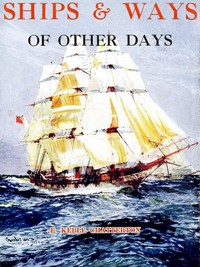
Ships & Ways of Other Days — Inside the Classic can be approached with a clearer sense of reading commitment from its source measurements: 94,420 words, 6 hr 51 min estimated reading time, and 25 detected text sections.
The text analysis averages about 24.5 words per sentence, while the detected sections provide another way to judge how the source is divided.
Project Gutenberg metadata also associates the work with “Seafaring life,” connecting these edition facts with the source record’s subject description.
Explore this collection
These alternatives are selected using recorded categories and estimated reading time.
About 409 minutes
Science Fiction Utopias
93,849 recorded words. 2 minutes difference from this book's estimate.
View Gutenberg source #72747About 419 minutes
Science Fiction Utopias
96,162 recorded words. 8 minutes difference from this book's estimate.
View Gutenberg source #34675About 423 minutes
Science Fiction Utopias
97,279 recorded words. 12 minutes difference from this book's estimate.
View Gutenberg source #51143Search stored excerpts and compare books → Choose by your preferences →
Choices use stored catalog measurements. Estimates vary with reading speed. A shared category is a catalog label, not a claim that two books have the same argument or literary quality.
Search reads excerpt text stored with this catalog and links to its associated Gutenberg record. The connection is stored in the site database; this tool does not recheck that every excerpt is word-for-word identical to that external record. Excerpt search does not cover every chapter and does not verify historical publication dates.
Catalog snapshot checked: 2026-09-26. Coverage: 90 public books, 90 available source excerpts.
Calculated from edition completeness, EPUB availability, text structure and catalogue metadata. Not a user rating.
Total of 100 points, scaled to a 2.5-5.0 range. Editions with an empty description or a missing EPUB file are not scored.
Public-domain source text
The source text is kept in the dedicated reader, separate from this catalogue record and its commentary.
Chatterton opens with a vivid contrast: the reader is asked to imagine a tea-clipper before the wind, then immediately transported to a flat calm where the Santa Maria is carried onto a sandbank. This movement between stillness and action, between the romantic image of sail and the gritty reality of grounding, sets the pattern for the entire work. The author’s method is to place the reader on deck, watching the crew “lay out an anchor astern” or feeling the tiller refuse to move. He builds his history not from abstract dates but from the feel of hemp cordage, the diameter of a mainmast, the rust showing on iron nails.
Chatterton’s first chapters trace the shift from “river sailors rather than blue-water seamen” to ocean-going mariners. He lingers on the physical evidence: early Mediterranean anchors, the shape of a trireme’s prow as shown on a vase, the “Korax” boarding bridge in action. The reader is never allowed to forget that these vessels were built by hand, from available materials, and that each innovation—the lateen yard made of two pieces lashed together, the steering oar replaced by a tiller—was a hard-won response to a practical problem. The author’s eye for detail is forensic: he notes that the Viking anchor and block tackle are taken from Gustafson’s Norges Oldtid, and that the Roman ship found at Westminster still shows the shape of its hull. This is not a story of inevitable progress but of incremental, often fragile, achievement.
Throughout the book, Chatterton returns to the physical weight and texture of maritime equipment. He describes the Santa Maria’s mainmast as measuring 2½ feet in diameter, her yards made of two pieces lashed together, her hull painted with tar and greased below the waterline. He notes that hammocks were introduced by Columbus after contact with West Indians, and that the admiral’s cabin contained a press for clothes, a stool, two chairs, and a dining-table for two. These details are not decorative; they are the evidence from which the author builds his argument about how ships were actually used. The same attention is given to earlier vessels: the Roman ship’s bronze figurehead, the Greek penteconter’s rowing arrangement, the Viking rowlock and rivet. By insisting on the material reality of each craft, Chatterton makes the reader feel the heft of history.
Chatterton is particularly interested in how sailors found their way before modern navigation. He describes Columbus using an astrolabe, but also notes the older methods: the Mediterranean habit of coasting, the Viking reliance on landmarks and sea signs, the medieval use of the lead line. The author’s treatment of the Santa Maria’s grounding is instructive: Columbus’s first command was to “lay out an anchor astern” to kedge her off, but the crew rowed away instead. Chatterton uses this moment to show that seamanship and navigation are not the same thing—Columbus was “every bit as fine a seaman as he was a clever navigator.” The book repeatedly contrasts the theoretical knowledge of charts and instruments with the practical judgment needed to handle a ship in a crisis.
Chatterton’s descriptions of hull construction are among his most precise. He notes that the Santa Maria’s hull was “constructed somewhat roughly,” with iron nails already showing rust, and that the ship was beached twice during the voyage to be greased below the waterline. He compares this to earlier Mediterranean practice, where hulls were often built shell-first, and to the clinker-built Viking ships. The author’s interest is not in naval architecture as an abstract science but in how the shape of a hull determined a ship’s behavior at sea. He points out that the Santa Maria’s quarter-deck extended from about midships to the stern, with a poop-deck above, and that the tiller came in under the quarter-deck. These details are not random; they explain why the ship handled as she did, and why Columbus’s cabin was where it was.
Chatterton’s method is cumulative: each chapter adds another layer of practical knowledge, from the feel of a steering oar to the weight of an anchor. Readers who want to understand how ships actually worked—how they were built, rigged, and handled—will find this book a steady, detailed guide. The author’s own voice is that of a knowledgeable enthusiast, not a dry academic, and his willingness to pause over a single piece of gear or a single moment of crisis gives the history a lived-in quality. Approach the book as a series of close observations rather than a sweeping narrative, and its strengths become clear.
I have often set Chatterton's old ships sailing through my mind, their rigging humming with purpose and patience. There is a discipline to that seamanship, a quiet order, which reminds me of the steady drills in the Manual of Military Training Second, Revised Edition — Reading Companion. Both speak of hands learning their work, of readiness held calmly, like two old comrades sharing a lantern.
Save your reaction, strongest insight, and memorable passage.