About 147 minutes
The Thirty Years War — Volume 01 — Reading Notes
Science Fiction Utopias
33,707 recorded words. 21 minutes difference from this book's estimate.
View Gutenberg source #6770
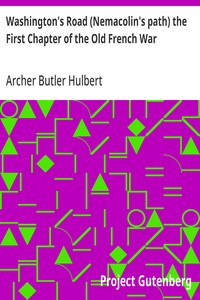
For Washington's Road (Nemacolin's path) the First Chapter of the Old French War — Themes and Context, the stored edition analysis reports 38,474 words, 2 hr 48 min estimated reading time, and 5 detected text sections.
The text analysis averages about 24.8 words per sentence, while the detected sections provide another way to judge how the source is divided.
Project Gutenberg metadata also associates the work with “United States -- History -- French and Indian War, 1754-1763,” connecting these edition facts with the source record’s subject description.
Explore this collection
These alternatives are selected using recorded categories and estimated reading time.
About 147 minutes
Science Fiction Utopias
33,707 recorded words. 21 minutes difference from this book's estimate.
View Gutenberg source #6770About 192 minutes
Science Fiction Utopias
44,028 recorded words. 24 minutes difference from this book's estimate.
View Gutenberg source #7259About 120 minutes
Science Fiction Utopias
27,389 recorded words. 48 minutes difference from this book's estimate.
View Gutenberg source #44408Search stored excerpts and compare books → Choose by your preferences →
Choices use stored catalog measurements. Estimates vary with reading speed. A shared category is a catalog label, not a claim that two books have the same argument or literary quality.
Search reads excerpt text stored with this catalog and links to its associated Gutenberg record. The connection is stored in the site database; this tool does not recheck that every excerpt is word-for-word identical to that external record. Excerpt search does not cover every chapter and does not verify historical publication dates.
Catalog snapshot checked: 2026-09-26. Coverage: 90 public books, 90 available source excerpts.
Calculated from edition completeness, EPUB availability, text structure and catalogue metadata. Not a user rating.
Total of 100 points, scaled to a 2.5-5.0 range. Editions with an empty description or a missing EPUB file are not scored.
Public-domain source text
The source text is kept in the dedicated reader, separate from this catalogue record and its commentary.
Archer Butler Hulbert's Washington's Road (Nemacolin's Path) is the third volume in his Historic Highways of America series, but it is not a generic transportation history. The book uses a single trail—the Indian path improved by Washington in 1754—as a fixed point to examine the military and political opening of the French and Indian War. Hulbert combines documentary evidence with on-site inspection, noting, for instance, that a modern road on Laurel Hill still follows the track of Washington's Road and passes near the ravine where Washington encountered Jumonville's party. The catalog lists this work under Science Fiction & Utopias, a category that bears no relation to its content; the text is a work of early twentieth-century American history, grounded in correspondence, journals, and official instructions.
Hulbert does not simply narrate events; he argues that the road itself shaped the conflict. The preface states the pages are “largely devoted to Washington and his times as seen from the standpoint of the road he opened across the Alleghanies in 1754.” This approach allows him to integrate topography with strategy. For example, he reproduces a map from the British Museum showing “the country between Wills Creek and Lake Erie” with French fort designs, grounding Washington's movements in geographic reality. The excerpts show that Hulbert pays close attention to the physical details of the route: the location of Shingiss's village, the site of Fort Necessity, and the ledge from which Washington's party opened fire. By treating the road as a primary source, he offers a concrete alternative to purely political or biographical accounts.
Hulbert emphasizes the publication of Washington's journal as a turning point. He writes that “no literary production of a youth of twenty-one ever electrified the world” as did that journal, which was “copied far and wide” in colonial newspapers and printed in London by the British government. The excerpts include Washington's instructions from Governor Dinwiddie, which reveal the precise chain of command and the defensive-yet-aggressive posture ordered: “act on the Defensive, but in Case any Attempts are made to obstruct the Works … make Prisoners of or kill and destroy them.” Hulbert uses these documents to show how Washington's mission, though a diplomatic failure, provided the intelligence and justification for war. The journal's “manly, artless way” is cited as key to its effectiveness, a stylistic observation that distinguishes Hulbert's analysis from mere summary.
The Project Gutenberg record classifies this book as Science Fiction & Utopias, a category that fits none of the content. The text is a work of historical scholarship, part of a series on American highways, and draws on archives, maps, and field surveys. Hulbert's method is empirical: he notes the correction of spelling errors, the relocation of images in the digital edition, and the movement of footnotes to the end. The excerpts include detailed instructions to Washington and Colonel Fry, reproduced verbatim from official records. Readers expecting speculative fiction will find instead a close examination of 1750s frontier logistics, Native American diplomacy, and the early career of George Washington. The mismatch highlights the limitations of automated cataloging and the importance of examining the actual text.
Readers should approach this volume as a focused case study in military geography and documentary history. Hulbert's reliance on primary sources—letters, journals, maps, and official orders—makes the book valuable for those interested in the mechanics of colonial warfare rather than broad narrative. The digital edition's inclusion of the original illustrations and maps, though repositioned, preserves the visual evidence that Hulbert considered essential. For a full understanding, consult the companion volumes in the Historic Highways series, which provide broader context for the road networks of early America.
There’s something humbling about tracing Washington’s makeshift road through the Alleghanies, knowing how much depended on a few rough miles of wilderness. That same weight of consequences—how a single, calculated choice reshapes everything—came back to me while reading Shock and Awe — Achieving Rapid Dominance — Context and Discussion. Both feel less like histories than quiet reminders of how fragile our carefully laid paths turn out to be. Shock and Awe — Achieving Rapid Dominance — Context and Discussion lingers the same way.
Capture what you thought, learned, and would like to remember.