About 147 minutes
The Thirty Years War — Volume 01 — Reading Notes
Science Fiction Utopias
33,707 recorded words. 27 minutes difference from this book's estimate.
View Gutenberg source #6770
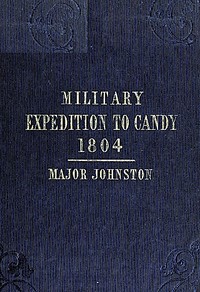
This digital edition of Narrative of the Operations of a Detachment in an Expedition to Candy, in the Island of Ceylon, in the Year 1804 With Some Observations on the Previous Campaign, and — Story, Setting & Ideas is described by source-level measurements including 27,389 words, 2 hr estimated reading time, and 3 detected text sections.
The text analysis averages about 31.2 words per sentence, while the detected sections provide another way to judge how the source is divided.
Project Gutenberg metadata also associates the work with “Sri Lanka -- History -- 1505-1948,” connecting these edition facts with the source record’s subject description.
Explore this collection
These alternatives are selected using recorded categories and estimated reading time.
About 147 minutes
Science Fiction Utopias
33,707 recorded words. 27 minutes difference from this book's estimate.
View Gutenberg source #6770About 75 minutes
Science Fiction Utopias
17,105 recorded words. 45 minutes difference from this book's estimate.
View Gutenberg source #47216About 168 minutes
Science Fiction Utopias
38,474 recorded words. 48 minutes difference from this book's estimate.
View Gutenberg source #40932Search stored excerpts and compare books → Choose by your preferences →
Choices use stored catalog measurements. Estimates vary with reading speed. A shared category is a catalog label, not a claim that two books have the same argument or literary quality.
Search reads excerpt text stored with this catalog and links to its associated Gutenberg record. The connection is stored in the site database; this tool does not recheck that every excerpt is word-for-word identical to that external record. Excerpt search does not cover every chapter and does not verify historical publication dates.
Catalog snapshot checked: 2026-09-26. Coverage: 90 public books, 90 available source excerpts.
Calculated from edition completeness, EPUB availability, text structure and catalogue metadata. Not a user rating.
Total of 100 points, scaled to a 2.5-5.0 range. Editions with an empty description or a missing EPUB file are not scored.
Public-domain source text
The source text is kept in the dedicated reader, separate from this catalogue record and its commentary.
Major Arthur Johnston’s 1854 narrative recounts a British detachment’s 1804 expedition to Kandy, Ceylon, drawing on his command of a pioneer corps and remote districts. The text opens with a dedication to Sir David Dundas, framing the work as a contribution to military knowledge on a warfare style distinct from European tactics. Johnston’s preface establishes his authority through prior road-building for an embassy and civil-military roles, grounding the account in personal experience rather than secondhand report.
The excerpts reveal Johnston’s focus on logistical constraints and tactical choices. After crossing a river, he notes the loss of one raft and the near-unmanageability of the other, forcing a difficult crossing of the 3rd company of Sepoys and the rear guard. With ammunition reduced to two small barrels of 800 rounds each and several troops without cartridges, he decides to retreat via the Trincomalé road, judging it less obstructed than the Columbo route, which would require storming two posts. He abandons bullocks and orders each soldier to carry six days’ rice, destroying remaining stores. An accidental powder fire kills and wounds coolies, causing confusion exploited by the enemy. These details highlight the interplay of terrain, supply, and enemy action in shaping Johnston’s decisions.
Johnston repeatedly emphasizes the physical environment and Candian methods. The river’s rapid rise after rain, typical of mountainous countries, impedes crossing. On the march, the Candians fell trees to block roads and build breastworks, forcing laborious clearance under fire. Johnston describes a night of incessant rain without means to prepare victuals, hearing trees felled below. The pass descent costs five Europeans, eight Sepoys, and thirty followers killed or wounded. The enemy’s use of terrain—posting on hills commanding passes—is presented as a deliberate tactic, contrasting with European open-field engagements. Johnston’s observations on Candian warfare, promised in the title, are thus embedded in the operational narrative.
The narrative’s voice is that of a commanding officer justifying decisions. Johnston uses precise dates (e.g., “10.—In the course of the morning”) and quantifies losses, ammunition, and distances (142 miles from Trincomalé). He names subordinates like Lieutenant Vincent, whose wound he feels as a severe deprivation. The prose is matter-of-fact, avoiding embellishment: “the constant skirmishing of the last two days had reduced our stock of ammunition.” The dedication and preface frame the work as a professional contribution, not a popular history. This structure—chronological entries with tactical reasoning—reflects Johnston’s intent to benefit future operations by showing how difficulties might be removed or lessened.
Readers should approach this narrative as a primary source on early 19th-century British colonial campaigning, not a comprehensive history of the Kandyan Wars. Johnston’s perspective is that of a field commander focused on his detachment’s survival; the Candian viewpoint is absent. The text rewards attention to logistical details and the author’s implicit assumptions about terrain and enemy capabilities. For context, consulting maps of Ceylon’s central highlands may clarify the routes described.
That book about the Kandyan detachment stayed with me—the quiet weight of mud, heat, and decisions made far from home. It reminded me of something older and slower, where wars stretch into seasons and survival becomes a meditation. I found myself thinking of that while rereading The Thirty Years War — Volume 01 — Reading Notes. Both left a strange aftertaste, not of glory, but of patient, ordinary endurance.
Use these questions to collect your thoughts before moving on.