About 411 minutes
Ships & Ways of Other Days — Inside the Classic
Science Fiction Utopias
94,420 recorded words. 2 minutes difference from this book's estimate.
View Gutenberg source #60226
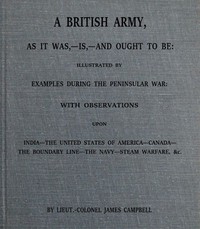
Before opening A British army, as it was,--is,--and ought to be — Background and Themes, the edition data offers a quick orientation: 93,849 words, 6 hr 49 min estimated reading time, and 14 detected text sections.
The text analysis averages about 45.7 words per sentence, while the detected sections provide another way to judge how the source is divided.
Project Gutenberg metadata also associates the work with “Great Britain. Army,” connecting these edition facts with the source record’s subject description.
Explore this collection
These alternatives are selected using recorded categories and estimated reading time.
About 411 minutes
Science Fiction Utopias
94,420 recorded words. 2 minutes difference from this book's estimate.
View Gutenberg source #60226About 419 minutes
Science Fiction Utopias
96,162 recorded words. 10 minutes difference from this book's estimate.
View Gutenberg source #34675About 423 minutes
Science Fiction Utopias
97,279 recorded words. 14 minutes difference from this book's estimate.
View Gutenberg source #51143Search stored excerpts and compare books → Choose by your preferences →
Choices use stored catalog measurements. Estimates vary with reading speed. A shared category is a catalog label, not a claim that two books have the same argument or literary quality.
Search reads excerpt text stored with this catalog and links to its associated Gutenberg record. The connection is stored in the site database; this tool does not recheck that every excerpt is word-for-word identical to that external record. Excerpt search does not cover every chapter and does not verify historical publication dates.
Catalog snapshot checked: 2026-09-26. Coverage: 90 public books, 90 available source excerpts.
Calculated from edition completeness, EPUB availability, text structure and catalogue metadata. Not a user rating.
Total of 100 points, scaled to a 2.5-5.0 range. Editions with an empty description or a missing EPUB file are not scored.
Public-domain source text
The source text is kept in the dedicated reader, separate from this catalogue record and its commentary.
Lieutenant-Colonel James Campbell opens his 1840 treatise with a dedication that frames the entire work: he writes as a soldier who has “seen much service in all parts of the world,” and his stated aim is the “honour and renown of my companions in arms, and the good of the army in general.” The title’s tripartite structure—what the army was, is, and ought to be—announces a comparative method that runs through the book. Campbell repeatedly contrasts past practice with present shortcomings, then offers prescriptive remedies. His voice is direct, often impatient, and unafraid to name individuals, as when he recalls Major Smith of the 45th regiment, who “fell fighting gloriously, but too rashly” at Busaco. These personal recollections give the reform arguments a concrete, anecdotal texture.
Campbell does not rely solely on abstract principles; he populates his pages with named officers and specific incidents. The memory of Major Smith, who “had also sometimes a very odd way of expressing himself,” is used to illustrate the danger of excessive prudence in command. Smith’s reported remark—“I don't like your prudent officers, Sir, who deal in long shots”—becomes a miniature case study in Campbell’s larger critique of cautious tactics. Similarly, he invokes General Sir Thomas M. Brisbane as a living witness who can verify or correct his statements. This technique gives the reader a sense of being inside a regimental mess, listening to seasoned veterans debate. The anecdotes are never decorative; they carry evidentiary weight, grounding Campbell’s proposals in observed experience rather than theory.
Campbell’s reform agenda is strikingly concrete. He devotes careful attention to the physical infrastructure of punishment, recommending “small, dark, dry, and well ventilated cells” for solitary confinement, where silence “will soon be found to constitute the severest part of the punishment.” Yet he immediately notes that such measures cannot be applied when regiments are in the field, revealing a practical awareness of the gap between garrison discipline and campaign realities. He also addresses the chain of command, complaining that “the link of responsibility” is never fully maintained: majors are not made answerable for their wings, and captains are “almost never interfered with by the majors.” These structural observations are interwoven with proposals for improving marksmanship, including earth mounds for ball practice and increased ammunition allowances, all aimed at making the soldier “more than a match for the Yankee Back-woodsmen.”
Campbell’s prose moves between formal exposition and conversational asides. He apologizes for “taking up the reader's time” with a digression about his ancestor, then immediately launches into another anecdote. This self-interrupting style creates a sense of urgency: the author has much to say and little patience for decorum. His sentences often pile up qualifications and afterthoughts, as when he recommends rewards for marksmanship “with a superior description of musket, having a good percussion lock, serviceable in wet as well as in dry weather.” The pace quickens when he is indignant, slows when he details regulations. Readers should attend to these shifts in tempo; they signal which topics Campbell considers most pressing. The overall effect is that of a seasoned officer speaking extemporaneously, trusting his experience more than rhetorical polish.
Campbell’s book is best approached as a period document in military reform literature, not a finished blueprint. His reliance on personal authority and named witnesses means that every claim is tied to a specific time and place—the Peninsular War, the 3rd Division, the opinions of Major Smith. Readers interested in the texture of early Victorian military thinking will find a voice that is both idiosyncratic and representative. The work rewards those who read slowly enough to catch the practical details buried inside Campbell’s looping sentences.
Sometimes I think about Campbell, forty years after Waterloo, fussing over muskets and discipline—how he wanted soldiers to think for themselves, not just obey. That same stubborn hopefulness glimmers through History of the United Netherlands, 1588-89 — Reading Companion, where reforms stall, and yet people keep trying. It's a quieter kind of courage, maybe, the one that outlasts battles.
Save your reaction, strongest insight, and memorable passage.