About 50 minutes
History of the United Netherlands, 1588-89 — Reading Companion
Science Fiction Utopias
11,474 recorded words. 3 minutes difference from this book's estimate.
View Gutenberg source #4859
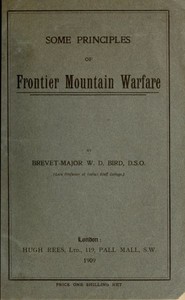
The source record for Some Principles of Frontier Mountain Warfare — Themes and Context measures this digital text at 12,043 words, 53 min estimated reading time, and 2 detected text sections.
The text analysis averages about 28.7 words per sentence, while the detected sections provide another way to judge how the source is divided.
Project Gutenberg metadata also associates the work with “Military art and science,” connecting these edition facts with the source record’s subject description.
Explore this collection
These alternatives are selected using recorded categories and estimated reading time.
About 50 minutes
Science Fiction Utopias
11,474 recorded words. 3 minutes difference from this book's estimate.
View Gutenberg source #4859About 46 minutes
Science Fiction Utopias
10,486 recorded words. 7 minutes difference from this book's estimate.
View Gutenberg source #56638About 75 minutes
Science Fiction Utopias
17,105 recorded words. 22 minutes difference from this book's estimate.
View Gutenberg source #47216Search stored excerpts and compare books → Choose by your preferences →
Choices use stored catalog measurements. Estimates vary with reading speed. A shared category is a catalog label, not a claim that two books have the same argument or literary quality.
Search reads excerpt text stored with this catalog and links to its associated Gutenberg record. The connection is stored in the site database; this tool does not recheck that every excerpt is word-for-word identical to that external record. Excerpt search does not cover every chapter and does not verify historical publication dates.
Catalog snapshot checked: 2026-09-26. Coverage: 90 public books, 90 available source excerpts.
Calculated from edition completeness, EPUB availability, text structure and catalogue metadata. Not a user rating.
Total of 100 points, scaled to a 2.5-5.0 range. Editions with an empty description or a missing EPUB file are not scored.
Public-domain source text
The source text is kept in the dedicated reader, separate from this catalogue record and its commentary.
Brevet-Major W.D. Bird opens his 1909 treatise with a firm declaration: the underlying principles of strategy and tactics are immutable, but their application must be continually adapted to circumstances. He warns that formalism in military operations is disastrous, and that an army relying on fixed rules will defeat itself. Instead, each problem must be considered on its merits. This insistence on flexibility over rigidity sets the tone for a work that is less a manual of procedures and more a guide to thinking about warfare in the demanding environment of the Indian frontier.
Bird immediately confronts a central paradox of mountain warfare: large armies risk starvation, small armies risk defeat. He quotes a French king on Spain to underscore the difficulty of determining force size in a region with few natural resources and a hardy but sparse population. The enemy—the Pathan tribes of the North West Frontier—are described as brave, inured to hardship, and some with training in the Indian army, giving them tactical knowledge. Bird argues that columns should be kept small for mobility, but not so small as to invite defeat. The goal is to induce the tribesmen to stand and fight, inflicting casualties they can ill afford, especially in arms. Commanders need not fear casualties if the enemy suffers equally, as close fighting favors trained soldiers.
Bird emphasizes that the enemy will rarely fight on favorable terms unless outwitted or surprised. He recommends night operations and dawn attacks, as the tribesmen are not often abroad early. Envelopment—attacking front and flank—is effective, but requires holding the enemy in frontal attack to distract them from outflanking moves. If neither envelopment nor night operations are possible, Bird suggests stratagems like feigned retirement or baiting with transport animals to tempt the Pathans from their hills. He advises against mere frontal attack as costly and ineffective. A bold front and ready stratagem cause the enemy to lose heart, while hesitation is quickly observed.
In minor tactics, Bird warns against seeking shelter in hollows or nullahs, as these are likely marked by enemy riflemen. Infantry should advance up salients, securing flanks and providing mutual fire support. Reserves should be pushed close to the firing line or provide covering fire from behind or on the flanks. Fire should be reserved until units have closed on the enemy, to prevent early evacuation of a position. Because enemy fire, though accurate, likely lacks volume, widely extended formations are unnecessary. Bird notes that the procedure for gaining ground and assaulting requires no modification from standard training manuals. Artillery must be handled with discretion and be on guard against counter-battery fire.
Bird stresses the importance of good information, staff work, and inter-communication. He argues that British advantage in training and armament allows dispensing with a central general reserve, instead disposing troops to insure envelopment. All ranks should be imbued with the spirit of mutual support. When a post or isolated detachment needs assistance, indirect pressure—diverting the enemy's attention—can be more rapid and effective than direct reinforcement. Bird's emphasis on adaptability and psychological insight into the enemy's mindset runs throughout: he advises commanders to remember that hesitation is quickly observed, but a bold front and stratagem cause the enemy to lose heart.
Bird's work is not a comprehensive field manual but a concise set of principles grounded in the specific conditions of the Indian frontier. Readers should note that the excerpts focus on tactical and operational advice; the full text may also address organization, equipment, and logistics. Bird's repeated warnings against formalism and his insistence on adapting principles to circumstances make this a valuable document for understanding early 20th-century British military thought in colonial mountain warfare.
Reading Major Bird’s treatise on frontier skirmishes, I found myself thinking less of maps and more of the quiet lists in The Waterloo Roll Call With Biographical Notes and Anecdotes — Reading Companion. Both feel like faded roll-calls of men, patiently named, their small stories tucked beside dusty strategy. Strange, how a manual on stone-walls and ambush can summon the echo of an older, greener field.
Build a private reading journal entry for this title.