About 50 minutes
History of the United Netherlands, 1588-89 — Reading Companion
Science Fiction Utopias
11,474 recorded words. 4 minutes difference from this book's estimate.
View Gutenberg source #4859
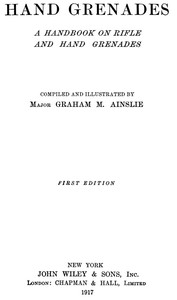
Hand Grenades: A handbook on rifle and hand grenades — Key Ideas to Explore can be approached with a clearer sense of reading commitment from its source measurements: 10,486 words, 46 min estimated reading time, and 15 detected text sections.
The text analysis averages about 12.7 words per sentence, while the detected sections provide another way to judge how the source is divided.
Project Gutenberg metadata also associates the work with “Grenades,” connecting these edition facts with the source record’s subject description.
Explore this collection
These alternatives are selected using recorded categories and estimated reading time.
About 50 minutes
Science Fiction Utopias
11,474 recorded words. 4 minutes difference from this book's estimate.
View Gutenberg source #4859About 53 minutes
Science Fiction Utopias
12,043 recorded words. 7 minutes difference from this book's estimate.
View Gutenberg source #55185About 22 minutes
Science Fiction Utopias
4,949 recorded words. 24 minutes difference from this book's estimate.
View Gutenberg source #66799Search stored excerpts and compare books → Choose by your preferences →
Choices use stored catalog measurements. Estimates vary with reading speed. A shared category is a catalog label, not a claim that two books have the same argument or literary quality.
Search reads excerpt text stored with this catalog and links to its associated Gutenberg record. The connection is stored in the site database; this tool does not recheck that every excerpt is word-for-word identical to that external record. Excerpt search does not cover every chapter and does not verify historical publication dates.
Catalog snapshot checked: 2026-09-26. Coverage: 90 public books, 90 available source excerpts.
Calculated from edition completeness, EPUB availability, text structure and catalogue metadata. Not a user rating.
Total of 100 points, scaled to a 2.5-5.0 range. Editions with an empty description or a missing EPUB file are not scored.
Public-domain source text
The source text is kept in the dedicated reader, separate from this catalogue record and its commentary.
Major Graham M. Ainslie's 1917 handbook opens with a definition that grounds the weapon in historical lineage: grenades were used by grenadiers until the late seventeenth century, then revived at Mafeking and in the Russo-Japanese War. The author states that the work is 'the result of practical experience in the present war,' and the text bears this out with a focus on immediate, actionable knowledge. The preface promises 'only information absolutely necessary,' and the content delivers on that promise through terse, procedural entries.
The handbook’s core consists of step-by-step instructions for making grenades 'safe' or 'alive' and for using them against the enemy. For each model—spherical, stick cylinder, cylindrical, oyster shell, parachute—the text follows a rigid three-part structure: how to make safe, how to make alive, how to use. The language is stripped of explanation: 'Screw out the special lighter, taking care not to pull the wire.' The reader is assumed to be a soldier under training, not an engineer. Notes on fuse burn times (e.g., 'seven seconds, but another lighter which burns for five seconds—painted red—is also provided') underscore the life-or-death stakes of memorizing these details.
The table of contents reveals a tactical arc beyond mere weapon description. Chapters on 'Clearing a Trench from a Flank,' 'Frontal Attack,' and 'Trench Storming Parties' situate the grenade as a tool for specific infantry operations. The introduction asserts that grenades have 'played a most important part in every successful operation carried out by British troops on the Western front,' and that they are essential in 'house-to-house and cellar fighting.' The handbook thus functions as both a technical manual and a tactical primer, reflecting the close-quarters reality of World War I trench warfare.
Ainslie emphasizes the importance of the book's illustrations, which he describes as 'accurate drawings of grenades now in use.' He advises the student to 'refer constantly to the illustrations' to grasp points 'inadequately treated in any existing work.' The text itself is spare, relying on diagrams to convey visual details that words alone cannot. The preface also notes that the book is arranged 'so simply that a person with a very little previous knowledge of the subject may be able to grasp both the data given, and the principles, and methods.' This pedagogical intent shapes the entire work, making it a self-contained training aid for the novice grenadier.
Readers should approach this handbook as a primary source on World War I military technology and training. The catalog subject 'Grenades' is accurate, but the excerpts reveal a work equally concerned with tactics, safety procedures, and the physical handling of munitions. The text’s brevity and directness reflect its purpose: to prepare soldiers for the specific, dangerous act of throwing a grenade in combat.
That rainy afternoon, the 1917 grenade manual felt impossibly distant—yet its matter-of-fact lists of names and fuses had a strange intimacy. Turning pages, I remembered another roll call, men whose stories were equally brief and numbered. The wet window blurred outside, and I reached for The Waterloo Roll Call With Biographical Notes and Anecdotes — Reading Companion, finding the same quiet echo of vanished hands.
Save your reaction, strongest insight, and memorable passage.