About 46 minutes
Hand Grenades: A handbook on rifle and hand grenades — Key Ideas to Explore
Science Fiction Utopias
10,486 recorded words. 24 minutes difference from this book's estimate.
View Gutenberg source #56638
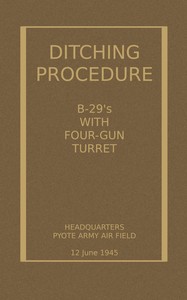
Before opening Ditching Procedure, B-29s with Four-Gun Turret — Reading Notes, the edition data offers a quick orientation: 4,949 words, 22 min estimated reading time, and 5 detected text sections.
The text analysis averages about 17.1 words per sentence, while the detected sections provide another way to judge how the source is divided.
Project Gutenberg metadata also associates the work with “B-29 (Bomber) -- Handbooks, manuals, etc.,” connecting these edition facts with the source record’s subject description.
Explore this collection
These alternatives are selected using recorded categories and estimated reading time.
About 46 minutes
Science Fiction Utopias
10,486 recorded words. 24 minutes difference from this book's estimate.
View Gutenberg source #56638About 50 minutes
Science Fiction Utopias
11,474 recorded words. 28 minutes difference from this book's estimate.
View Gutenberg source #4859About 53 minutes
Science Fiction Utopias
12,043 recorded words. 31 minutes difference from this book's estimate.
View Gutenberg source #55185Search stored excerpts and compare books → Choose by your preferences →
Choices use stored catalog measurements. Estimates vary with reading speed. A shared category is a catalog label, not a claim that two books have the same argument or literary quality.
Search reads excerpt text stored with this catalog and links to its associated Gutenberg record. The connection is stored in the site database; this tool does not recheck that every excerpt is word-for-word identical to that external record. Excerpt search does not cover every chapter and does not verify historical publication dates.
Catalog snapshot checked: 2026-09-26. Coverage: 90 public books, 90 available source excerpts.
Calculated from edition completeness, EPUB availability, text structure and catalogue metadata. Not a user rating.
Total of 100 points, scaled to a 2.5-5.0 range. Editions with an empty description or a missing EPUB file are not scored.
Public-domain source text
The source text is kept in the dedicated reader, separate from this catalogue record and its commentary.
This 1945 U.S. Army Air Forces manual, issued as an insert for multiple existing manuals, lays out ditching procedures for B-29 bombers equipped with four-gun turrets. The language is direct and imperative, reflecting the high stakes of emergency water landings. The opening memorandum, signed by Major Henry E. Bergschneider, establishes the document's authority and immediate applicability. The text balances technical precision with a sense of urgency, as seen in phrases like 'the importance of these approved methods cannot be stressed too highly.' It also acknowledges the provisional nature of the procedures, noting they are 'results of all ditching experiences to date' and subject to change as new data emerges.
The manual's voice is unmistakably military: commands are absolute, yet the text repeatedly admits uncertainty. The opening paragraph credits Boeing for initial ditching positions, calling them 'as logical as could be devised without actual ditching experience.' This phrasing reveals a reliance on theory before real-world data. The document then asserts that changes have been 'based on actual ditching experience,' but immediately cautions that procedures are 'not to be considered permanent.' This tension between authoritative command and empirical humility runs throughout. The prohibition against modifications 'at the discretion of the airplane commander' underscores the hierarchy, while the acknowledgment that new characteristics will be incorporated shows a system open to revision. The voice is that of an institution learning from its mistakes, speaking with confidence but leaving room for future correction.
The manual's pace shifts noticeably from broad context to granular instruction. Early paragraphs establish the B-29's ditching superiority, citing buoyancy and float times—'at least ten (10) minutes and may float for several hours.' This general reassurance gives way to abrupt, terse commands: 'Ditching impacts are severe. Every precaution must be taken to pad against impact.' The sentence fragments and imperative mood accelerate the rhythm. Later sections, though not fully excerpted, likely continue this pattern, moving from overarching principles to step-by-step drills. The structure mirrors the psychological progression from understanding the aircraft's capabilities to executing precise actions under pressure. The repeated emphasis on practice—'ditching position practice, as a part of completed ditching drill, is a "MUST"'—reinforces the need for rote learning to overcome the chaos of an actual ditching.
Three details recur with notable frequency. First, buoyancy: the manual stresses that the B-29 'does not sink easily' and can float for extended periods, a point made twice in the opening section. This emphasis likely aims to boost crew confidence. Second, impact severity: the text warns that impacts are 'severe' and repeatedly instructs on padding—using parachutes, cushions, and clothing—and protecting the head with flak helmets only when braced. The instruction to 'flex legs to absorb the effects of a sudden jar' appears as a specific physical directive. Third, crew coordination: the manual addresses injured crew members, advising they be 'supported between the legs of other crew position,' a vivid detail that underscores the cramped, collaborative environment. These recurring elements—buoyancy, impact mitigation, and crew interdependence—form the manual's core concerns, each tied to the physical realities of ditching a large bomber.
Readers should approach this manual as a historical artifact of military aviation training, not a standalone narrative. The excerpts reveal a document shaped by wartime urgency and empirical feedback. Pay attention to the interplay between absolute commands and conditional language—this tension reflects the manual's dual purpose: to enforce discipline while acknowledging the limits of knowledge. The text rewards close reading for its technical specificity and the implicit human drama of crews preparing for the worst.
There’s something humbling about a manual written by people who actually had to use it, every line carrying the weight of real water and real fear. It reminds me of picking up The Thirty Years War — Volume 01 — Reading Notes and feeling that same quiet ache—how carefully we record survival, knowing the next chapter rarely asks for our opinion.
Answer a few questions and save a private reflection on this device.