About 48 minutes
The dread Apache: That early-day scourge of the Southwest — Reading Notes
Fantasy Juvenile Worlds
10,931 recorded words. 25 minutes difference from this book's estimate.
View Gutenberg source #69801
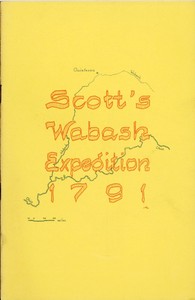
The source record for Scott's Wabash Expedition, 1791 — Reading Companion measures this digital text at 5,286 words, 23 min estimated reading time, and 1 detected text section.
The text analysis averages about 25.9 words per sentence, while the detected sections provide another way to judge how the source is divided.
Project Gutenberg metadata also associates the work with “Indians of North America -- Wars -- 1750-1815,” connecting these edition facts with the source record’s subject description.
Explore this collection
These alternatives are selected using recorded categories and estimated reading time.
About 48 minutes
Fantasy Juvenile Worlds
10,931 recorded words. 25 minutes difference from this book's estimate.
View Gutenberg source #69801About 60 minutes
Fantasy Juvenile Worlds
13,604 recorded words. 37 minutes difference from this book's estimate.
View Gutenberg source #4850About 69 minutes
Fantasy Juvenile Worlds
15,697 recorded words. 46 minutes difference from this book's estimate.
View Gutenberg source #52640Search stored excerpts and compare books → Choose by your preferences →
Choices use stored catalog measurements. Estimates vary with reading speed. A shared category is a catalog label, not a claim that two books have the same argument or literary quality.
Search reads excerpt text stored with this catalog and links to its associated Gutenberg record. The connection is stored in the site database; this tool does not recheck that every excerpt is word-for-word identical to that external record. Excerpt search does not cover every chapter and does not verify historical publication dates.
Catalog snapshot checked: 2026-09-26. Coverage: 90 public books, 90 available source excerpts.
Calculated from edition completeness, EPUB availability, text structure and catalogue metadata. Not a user rating.
Total of 100 points, scaled to a 2.5-5.0 range. Editions with an empty description or a missing EPUB file are not scored.
Public-domain source text
The source text is kept in the dedicated reader, separate from this catalogue record and its commentary.
General Charles Scott's report of his 1791 expedition into the Wabash region, reprinted here from the Indianapolis Gazette, is a document of deliberate understatement. Scott commanded roughly 850 Kentucky volunteers on a diversionary raid meant to distract Indians while General Arthur St. Clair prepared his main army. The pamphlet, prepared by the Public Library of Fort Wayne and Allen County in 1953, presents Scott's account with modernized grammar, spelling, and punctuation, but the raw physicality of the march remains. Scott describes crossing “four large branches of the White River” and “deep clay bogs from one to five miles wide,” all while rain fell “in torrents every day.” The report is a study in contrasts: Scott's relative success against the backdrop of St. Clair's catastrophic defeat, and the gap between the commander's hopeful language and the grim reality of the terrain.
Scott's prose is notably restrained. He writes that he marched “rather with the hope than with the expectation of reaching the object sought that day,” a phrase that reveals both his determination and his awareness of the odds. His guides were “strangers to the country,” and his information was “greatly deficient.” Yet he never laments or complains; the tone remains factual, almost clinical. This restraint contrasts sharply with the physical suffering implied by the conditions: horses worn down, provisions destroyed, men struggling through bogs and brush. The report's emotional flatness may reflect military convention, but it also highlights Scott's focus on mission over morale. Readers should note how Scott's language shapes the narrative—what he chooses to emphasize (obstacles, speed, discovery) and what he omits (casualties, Indian resistance, the fate of Ouiatenon). The gaps in the text are as telling as the details.
The landscape dominates Scott's account. He catalogs obstacles with precision: “four large branches of the White River,” “many smaller streams with steep, muddy banks,” “deep clay bogs from one to five miles wide,” and “brush and briers” that made the bogs “almost impassable.” The weather compounds the difficulty: “Rain fell in torrents every day, with frequent blasts of wind and thunderstorms.” This is not a passive backdrop but an active force that “impeded my progress, wore down my horses, and destroyed my provisions.” Scott's description of the soil as “alternately interspersed with the most luxurious soil and with deep clay bogs” suggests a land of extremes—fertile yet treacherous. The contrast between the “luxurious soil” and the impassable bogs mirrors the larger tension between the promise of the Northwest Territory and the brutal reality of its conquest. The pamphlet's editorial modernization may smooth Scott's original grammar, but the visceral sense of mud and fatigue remains intact.
The foreword situates Scott's raid within a larger military context: Scott participated in Harmar's 1790 expedition, St. Clair's 1791 campaign, and Wayne's 1794 victory at Fallen Timbers. The pamphlet notes that Scott “was more successful than his commander was destined to be,” a pointed reference to St. Clair's devastating loss just months later. This framing invites readers to view Scott's report as a counterpoint to disaster. Scott's success—reaching Ouiatenon and distracting the Indians—is measured not by territory gained but by survival and mission completion. The report itself never mentions St. Clair or the larger campaign; it is a self-contained operational narrative. Yet the foreword's hint of hindsight creates a tension: we know what Scott could not, that his commander would soon suffer one of the worst defeats in U.S. Army history. This irony gives Scott's cautious optimism a tragic edge. The pamphlet thus functions as both a primary source and a historical commentary, its brevity belying the weight of what it implies.
This pamphlet offers a compact entry point into the logistics and psychology of early U.S. expansion into the Northwest Territory. Readers may wish to compare Scott's account with other contemporary reports, particularly those of Harmar and St. Clair, to gauge how military leaders framed success and failure. The editorial changes in grammar, spelling, and punctuation are worth noting: they smooth the text but may obscure Scott's original voice. Consider how the pamphlet's 1953 publication date—a century and a half after the events—shapes its presentation. The document is as much a product of mid-century local history efforts as it is a window into 1791.
There’s something touching about old pamphlets, how they stitch a single voice across centuries. I found myself thinking of General Scott’s weary scribble, the mud and doubt of that raid, while turning to the quieter pages of the Fort George paper. Both feel like lantern light—brief, determined, and somehow warm against the dark. Battle of Fort George: A paper read on March 14th, 1896 — Reading Companion holds that same flicker. I keep both close now.
Build a private reading journal entry for this title.