About 350 minutes
The Story of the Highland Regiments — Context and Discussion
Historical Psychological Social Fiction
80,468 recorded words. 38 minutes difference from this book's estimate.
View Gutenberg source #57897
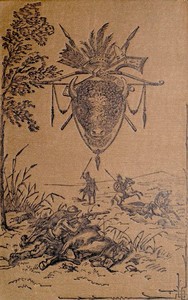
For Red Eagle and the Wars With the Creek Indians of Alabama. — Themes and Context, the stored edition analysis reports 71,540 words, 5 hr 12 min estimated reading time, and 7 detected text sections.
The text analysis averages about 29.1 words per sentence, while the detected sections provide another way to judge how the source is divided.
Project Gutenberg metadata also associates the work with “Weatherford, William, approximately 1780-1824,” connecting these edition facts with the source record’s subject description.
Explore this collection
These alternatives are selected using recorded categories and estimated reading time.
About 350 minutes
Historical Psychological Social Fiction
80,468 recorded words. 38 minutes difference from this book's estimate.
View Gutenberg source #57897About 356 minutes
Historical Psychological Social Fiction
81,734 recorded words. 44 minutes difference from this book's estimate.
View Gutenberg source #68270About 267 minutes
Historical Psychological Social Fiction
61,388 recorded words. 45 minutes difference from this book's estimate.
View Gutenberg source #60449Search stored excerpts and compare books → Choose by your preferences →
Choices use stored catalog measurements. Estimates vary with reading speed. A shared category is a catalog label, not a claim that two books have the same argument or literary quality.
Search reads excerpt text stored with this catalog and links to its associated Gutenberg record. The connection is stored in the site database; this tool does not recheck that every excerpt is word-for-word identical to that external record. Excerpt search does not cover every chapter and does not verify historical publication dates.
Catalog snapshot checked: 2026-09-26. Coverage: 90 public books, 90 available source excerpts.
Calculated from edition completeness, EPUB availability, text structure and catalogue metadata. Not a user rating.
Total of 100 points, scaled to a 2.5-5.0 range. Editions with an empty description or a missing EPUB file are not scored.
Public-domain source text
The source text is kept in the dedicated reader, separate from this catalogue record and its commentary.
Eggleston opens with a preface that frankly acknowledges his work "makes no pretension to originality in its materials," listing a dozen sources from Parton's Jackson biography to Drake's Book of the Indians. This transparency sets the tone for a narrative that weaves together multiple accounts rather than claiming firsthand knowledge. The table of contents reveals a structure that alternates between Red Eagle's personal story—his birth, boyhood, and famous leap—and set-piece battles such as Burnt Corn, Fort Mims, and the Canoe Fight. Readers should note that the excerpts provided are incomplete; the full text likely contains additional episodes and character development not represented here.
The preface lists seven primary sources, including Pickett's History of Alabama and Meek's Romantic Passages in South-western History, signaling that Eggleston compiled his account from published works rather than original documents. He notes that many of these books were "long out of print" by 1878, making his synthesis valuable for contemporary readers. The list also includes official papers like Indian Affairs, American State Papers, suggesting an effort to balance anecdotal sources with government records. This bibliographic openness invites readers to treat the narrative as a constructed history, not a transparent chronicle.
One excerpt details a disastrous miscommunication: General Cocke attacked the Hillabee towns while a peace messenger was still en route, leading the Hillabees to believe Jackson was "implacable" and to join the hostile forces. Eggleston quotes Drake's Book of the Indians directly, reproducing the Indians' reasoning that "nothing short of their total destruction would satisfy him." The author then weighs Cocke's culpability, noting that while Cocke "did wrong in a military sense," his motives may have been "perfectly unselfish." This balanced treatment—citing a defense Cocke published in 1852—shows Eggleston's method of presenting multiple perspectives without resolving them.
Eggleston frequently interjects evaluative language, as when he writes that Cocke's action "led to disastrous results" and that historians "severely censure" him. He also uses phrases like "clearly culpable" and "palliate, not to excuse," revealing a moral framework that judges military decisions by their consequences. This voice is consistent with the preface's claim that the work is a history, not a novel, yet it employs novelistic techniques—such as the dramatic chapter title "Red Eagle's Leap"—to engage readers. The excerpts suggest a tension between objective reporting and partisan sympathy for Jackson's perspective.
The provided text breaks off during Cocke's supply difficulties and jumps to Project Gutenberg's boilerplate, so key episodes—Red Eagle's childhood, the Fort Mims massacre, the famous leap—are absent from the excerpts. Readers cannot assess how Eggleston handles Weatherford's personal agency or the Creek perspective beyond the Hillabee incident. The table of contents promises chapters on "Red Eagle as an Advocate of War" and "Romantic Incidents of the Fort Mims Affair," but without those sections, the portrayal of Weatherford remains fragmentary. The excerpts do confirm that Eggleston relies heavily on quoted sources, often reproducing long passages from Parton and Drake.
Readers approaching this work should treat it as a 19th-century compilation history, not a modern scholarly monograph. Eggleston's reliance on published sources and his moral commentary on military decisions shape the narrative as much as the events themselves. Pay attention to his source citations and evaluative language; they reveal the interpretive lens through which Red Eagle's story is filtered. The incomplete excerpts caution against assuming the full book's stance on Weatherford's character or the Creek War's causes.
Reading about the Hillabee peace blunder, I felt that old ache of orders gone wrong—lives lost to a broken promise. It reminded me of letters in Campaign of the Indus In a Series of Letters from an Officer of the Bombay Division — Reading Notes, where distance and miscommunication twist intent into tragedy. Both books left me staring at the wall, wondering how often history is just a chain of small, terrible misunderstandings.
Create a short personal record of your experience with this book.