About 45 minutes
Lincoln and the Sleeping Sentinel: The True Story — Text and Context
Historical Psychological Social Fiction
10,185 recorded words. 13 minutes difference from this book's estimate.
View Gutenberg source #48319
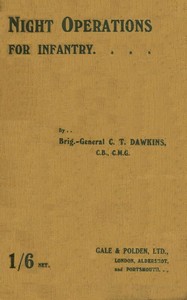
The catalog record for Night Operations for Infantry Compiled for the Use of Company Officers — Reading Companion provides practical reading context through 13,223 words, 58 min estimated reading time, and 8 detected text sections.
The text analysis averages about 27.7 words per sentence, while the detected sections provide another way to judge how the source is divided.
Project Gutenberg metadata also associates the work with “Infantry drill and tactics,” connecting these edition facts with the source record’s subject description.
Explore this collection
These alternatives are selected using recorded categories and estimated reading time.
About 45 minutes
Historical Psychological Social Fiction
10,185 recorded words. 13 minutes difference from this book's estimate.
View Gutenberg source #48319About 42 minutes
Historical Psychological Social Fiction
9,534 recorded words. 16 minutes difference from this book's estimate.
View Gutenberg source #69116About 82 minutes
Historical Psychological Social Fiction
18,748 recorded words. 24 minutes difference from this book's estimate.
View Gutenberg source #47493Search stored excerpts and compare books → Choose by your preferences →
Choices use stored catalog measurements. Estimates vary with reading speed. A shared category is a catalog label, not a claim that two books have the same argument or literary quality.
Search reads excerpt text stored with this catalog and links to its associated Gutenberg record. The connection is stored in the site database; this tool does not recheck that every excerpt is word-for-word identical to that external record. Excerpt search does not cover every chapter and does not verify historical publication dates.
Catalog snapshot checked: 2026-09-26. Coverage: 90 public books, 90 available source excerpts.
Calculated from edition completeness, EPUB availability, text structure and catalogue metadata. Not a user rating.
Total of 100 points, scaled to a 2.5-5.0 range. Editions with an empty description or a missing EPUB file are not scored.
Public-domain source text
The source text is kept in the dedicated reader, separate from this catalogue record and its commentary.
The manual opens by asserting that the Russo-Japanese War demonstrated a growing reliance on night attacks, and that future conflicts will compel similar methods. This claim frames the entire work as a response to a tactical shift, not a theoretical exercise. The author, Brigadier-General C. T. Dawkins, writes in a direct, prescriptive voice, often using first-person plural (“we”) to align himself with the officer-reader. The structure is methodical: each chapter breaks down a phase of night operations—elementary training, reconnaissance, the assault, defensive action—into numbered sub-sections. Recurring images of darkness, silence, and the fragility of communication run through the text, as when Dawkins warns that “sudden outbursts of fire without any due cause occasionally occur in all armies.”
The book’s first substantive chapter, “Elementary Instruction,” treats night operations as a set of physical skills to be drilled: training of vision, hearing, finding bearings, moving in the dark. This progression from individual senses to collective movement mirrors the manual’s larger arc. Dawkins insists that “constant practice” is the only way to acquire competence, and he repeatedly warns against neglecting fundamentals. The structure of the text itself enforces this—each new topic builds on the previous one, so that by the time the reader reaches “The Assault,” the earlier sensory exercises feel like necessary prerequisites. The author’s voice is that of a seasoned instructor who has seen what happens when training is skipped.
In the section on the assault, Dawkins presents a rare moment of explicit debate. He lists arguments for and against cheering during a night attack: cheers encourage one’s own men and discourage the enemy, but they also warn the enemy and reveal the attackers’ strength. His personal preference is for silence, because a silent assault may leave the enemy’s reserves uncertain of what has occurred, buying time for the attackers to consolidate. This passage is notable for its balanced, almost Socratic structure—Dawkins lays out both sides before giving his own reasoning. It also reveals a recurring concern: the difficulty of controlling information at night. The manual’s emphasis on “maintenance of connection” and “protection during operations” echoes this same anxiety about the breakdown of communication in darkness.
The chapter on defensive action opens with a blunt statement: “The first brunt of a night attack necessarily falls on the outposts.” Dawkins criticizes peacetime maneuvers for often declaring an armistice at night, which he believes robs infantry of realistic practice. He insists that outpost duty, though “extremely harassing,” must be performed under strict discipline. The text then details the positioning of piquets, the use of reconnoitring patrols, and the importance of entrenching. A striking detail is his admission that with weak companies, “the position of piquets, and even of groups, may be marked with flags”—a pragmatic concession that undercuts the ideal of constant vigilance. The section ends with a warning that passive defence is useless; a piquet’s best protection is a “resolute counter-attack.”
The final chapter, “Miscellaneous,” collects a range of practical devices and techniques: searchlights, flares, hand grenades, luminous discs, pocket electric lamps, connecting ropes, and methods for passing fences and entrenching by night. This section reads almost like an inventory, but it is unified by a recurring theme: the need to adapt ordinary equipment to the special conditions of darkness. For instance, Dawkins discusses how to use luminous discs for marking routes, and he devotes a paragraph to “knowledge of the moon and stars” as a navigational aid. The tone here is less urgent than in earlier chapters, more encyclopedic. Yet the final sentence—“Constant Practice the only Means of acquiring Knowledge”—ties the miscellany back to the manual’s central argument: no tool or technique can replace trained instinct.
Dawkins’ manual is best read as a sequence of escalating problems: from the individual soldier’s senses, to the squad’s movement, to the company’s assault, to the outpost’s defence. The recurring image is of a commander trying to impose order on a situation that constantly threatens to dissolve into confusion. Readers interested in military history will find a clear picture of pre-1917 British tactical thinking; those studying the literature of command may note how the manual’s structure itself enforces a kind of discipline on the reader, mirroring the training it advocates.
That rainy afternoon, the manual’s insistence on silence and preparation for chaos left me oddly hollow. I kept thinking about the men trained to move unseen, yet so exposed. Later, tracing the damp windowpane, I picked up Woman's Endurance — Key Ideas to Explore, and found a softer, though no less demanding, kind of fortitude. The discipline differed, but the quiet weight of holding oneself together felt familiar.
Your answers remain private and are stored only in this browser.