About 656 minutes
The Story of the British Army — A Reader’s Guide
Historical Psychological Social Fiction
150,823 recorded words. 243 minutes difference from this book's estimate.
View Gutenberg source #52723
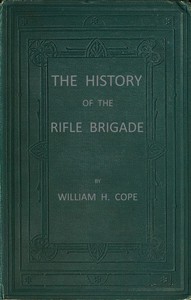
The source record for The History of the Rifle Brigade (the Prince Consort's Own) Formerly the 95th — Key Ideas to Explore measures this digital text at 206,548 words, 14 hr 59 min estimated reading time, and 43 detected text sections.
The text analysis averages about 24.1 words per sentence, while the detected sections provide another way to judge how the source is divided.
Project Gutenberg metadata also associates the work with “Great Britain. Army. Rifle Brigade (Prince Consort's Own),” connecting these edition facts with the source record’s subject description.
Explore this collection
These alternatives are selected using recorded categories and estimated reading time.
About 656 minutes
Historical Psychological Social Fiction
150,823 recorded words. 243 minutes difference from this book's estimate.
View Gutenberg source #52723About 462 minutes
Historical Psychological Social Fiction
106,070 recorded words. 437 minutes difference from this book's estimate.
View Gutenberg source #51087About 356 minutes
Historical Psychological Social Fiction
81,734 recorded words. 543 minutes difference from this book's estimate.
View Gutenberg source #68270Search stored excerpts and compare books → Choose by your preferences →
Choices use stored catalog measurements. Estimates vary with reading speed. A shared category is a catalog label, not a claim that two books have the same argument or literary quality.
Search reads excerpt text stored with this catalog and links to its associated Gutenberg record. The connection is stored in the site database; this tool does not recheck that every excerpt is word-for-word identical to that external record. Excerpt search does not cover every chapter and does not verify historical publication dates.
Catalog snapshot checked: 2026-09-26. Coverage: 90 public books, 90 available source excerpts.
Calculated from edition completeness, EPUB availability, text structure and catalogue metadata. Not a user rating.
Total of 100 points, scaled to a 2.5-5.0 range. Editions with an empty description or a missing EPUB file are not scored.
Public-domain source text
The source text is kept in the dedicated reader, separate from this catalogue record and its commentary.
The preface to this history immediately establishes a tension between official record and personal testimony. Sir William H. Cope, a former lieutenant of the Rifle Brigade, acknowledges that the 3rd Battalion left no formal record because it was disbanded before the Horse Guards required such documents. He therefore leans heavily on Quarter-Master Surtees’ autobiography, which he calls “most accurate in every particular.” This reliance on a non-commissioned officer’s perspective gives the narrative a ground-level texture, especially in later passages that describe soldiers hauling wood through ice or clinging to a slippery deck during a storm on Lake Superior.
The structure of the work is shaped by what is missing. Cope notes that the 3rd Battalion’s services would have been lost “had it not been for the facts and” (the excerpt cuts off, but the implication is clear). He supplements official gaps with materials like Colonel Leach’s “Rough Notes” and Surtees’ memoir. The result is a history that moves between battalions, signaled by extra blank space in the original text—a typographic cue that the reader must navigate shifts in time and location. This method produces a fragmented, episodic feel, as if the regiment’s story is pieced together from surviving fragments rather than delivered as a continuous chronicle.
One of the most vivid recurring elements is the presence of ice. In the excerpt, soldiers repeatedly contend with frozen conditions: ice collects in a bay, preventing a propeller from reaching the wharf; the deck is “as slippery as ice”; and the ship is driven onto a point called White Fish point. The men are forced to cut through ice, carry wood over it, and later land freight to lighten the vessel. These details are not merely scenic—they become a test of discipline. The captain later marvels at the soldiers’ coolness, and Cope uses such moments to illustrate the regiment’s character under duress. The lake itself, Superior, is described as having a “general rocky nature,” making the sandy bottom at White Fish point a rare piece of luck.
The narrative frequently shifts between Cope’s authorial voice and embedded first-hand accounts. The long passage about the shipwreck is presented as a direct report, possibly from an officer’s letter or journal, with phrases like “I then wrote to him requesting his opinion in writing.” This technique creates a layered texture: the reader hears the voice of a participant describing the storm, the captain’s fears, and the men’s obedience. Cope himself steps back, letting the primary source carry the drama. The effect is that the history feels less like a top-down command narrative and more like a collection of voices from within the ranks, each bringing a different angle on the same events.
Cope’s preface singles out Quarter-Master Surtees, who rose from private to quarter-master of the 3rd Battalion, as a key source. Surtees’ autobiography is praised for its accuracy, and Cope uses it to fill the void left by missing official records. This emphasis on a non-commissioned officer’s account is unusual for a 19th-century regimental history, which might typically rely on officers’ memoirs. It suggests that the book values practical experience over rank. In the shipwreck scene, the soldiers’ discipline is praised by the ship’s captain and officers, but the narrative itself comes from someone who was likely among them—perhaps Surtees himself. The result is a history that, at its best, captures the perspective of the men who carried the wood and stood still on the icy deck.
Readers approaching this history should attend to the typographic breaks between battalions and the shifts in narrative voice. The book is not a smooth chronology but a mosaic of official records, personal memoirs, and editorial commentary. The recurring images of ice and water serve as both literal obstacles and metaphors for the regiment’s endurance. By foregrounding sources like Surtees, Cope offers a view of military life that is often more immediate than the official dispatches.
That rainy afternoon, I kept returning to the riflemen’s icy shipwrecks, their grim endurance oddly soothing. The preface’s reliance on Surtees’ raw voice made me wonder how other regiments remembered their own disasters. Later, almost by accident, I found myself turning pages of A History of the 17th Lancers (Duke of Cambridge's Own) — Context and Discussion, chasing that same cold feeling of men holding formation against the tide.
Your answers remain private and are stored only in this browser.