
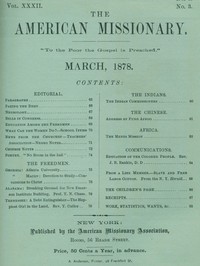
The American Missionary — Volume 32, No. 03, March, 1878 by Various
This isn't a novel with a single plot. 'The American Missionary — Volume 32, No. 03, March, 1878' is a monthly journal published by the American Missionary Association. Think of it as a blog or a newsletter from 1878, filled with field reports, letters, financial statements, and religious appeals. The 'story' it tells is the ongoing, messy work of Reconstruction in the American South, specifically through the lens of Northern missionaries and teachers dedicated to educating newly freed African Americans.
The Story
The issue opens with a sobering report from the field. A teacher in Tennessee writes about her school, listing how many students she has, what they're learning, and the constant lack of basic supplies. Another letter from Georgia might detail the community's hope and the subtle (or not-so-subtle) resistance from local white populations. The middle sections are often dry financial ledgers, showing donations from churches in New England and exactly where each dollar was spent—on a teacher's salary, on textbooks, on repairing a church roof used as a schoolhouse. The final part usually contains a more philosophical or theological essay, arguing why this missionary work is a moral imperative for the country.
Why You Should Read It
Reading this feels like listening in on a private meeting. The raw, administrative nature of it is what makes it powerful. You're not getting a polished historical summary written a century later. You're seeing the day-to-day grind of building a more just society, complete with budget shortfalls and worried letters. The courage of the teachers jumps off the page, but so does the immense scale of the challenge. It strips away romantic notions about the post-Civil War era and shows the gritty, unglamorous work of change. It makes you appreciate how fragile progress can be and how much depended on the stubborn dedication of ordinary people.
Final Verdict
This is for the curious reader who loves primary sources. Perfect for history buffs who want to move beyond textbooks, for educators who want to understand the roots of public schooling and racial inequality, or for anyone interested in the long, hard work of social justice. It’s not a light read, but it’s a profoundly authentic one. You won't find a thrilling narrative, but you will find something better: the real, unvarnished voice of a pivotal moment in American history, still asking questions we haven't fully answered today.
This masterpiece is free from copyright limitations. Feel free to use it for personal or commercial purposes.
Melissa Rodriguez
1 year agoSimply put, the flow of the text seems very fluid. This story will stay with me.
Aiden Flores
1 year agoGreat reference material for my coursework.
Christopher Walker
1 year agoAmazing book.


Joseph Lee
7 months agoMy first impression was quite positive because the historical context mentioned in the early chapters is quite enlightening. Top-tier content that deserves more recognition.