
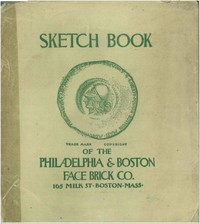
Sketchbook of the Philadelphia & Boston Face Brick Co.
Let's be clear from the start: this isn't a novel. There's no plot in the traditional sense. 'Sketchbook of the Philadelphia & Boston Face Brick Co.' is exactly what the title says—a reproduced collection of technical drawings from a 19th-century brick manufacturing company. The pages are filled with precise, hand-rendered illustrations of decorative brickwork: intricate patterns for facades, designs for corbels and arches, and detailed mouldings. It's a catalog of possibilities, a salesman's sample book meant to show architects and builders what beauty could be forged from fired clay.
The Story
The 'story' is one of quiet ambition and industrial craft. Published around the 1880s, this sketchbook was a tool of commerce. Each page is a proposal, a silent argument for choosing this company's bricks to build the banks, schools, and grand homes of a growing America. The narrative arc is the journey from raw material to artistic detail. You see the transition from simple, functional brick to elaborate ornamentation—roses, geometric patterns, and classical motifs—all intended to give ordinary buildings a soul and a statement. The only characters are the anonymous draftsmen, their skill evident in every confident ink line.
Why You Should Read It
You should pick this up if you've ever walked through an old neighborhood and glanced up, really looked up, at the details on a building's roof line or above a window. This book gives names and intentions to those details. It transforms a city stroll into a treasure hunt. For me, the power is in its anonymity and its specificity. We don't know the artists, but we see their pride. The company is long gone, but its aesthetic vision is literally embedded in the landscape. It's a profound reminder of the human desire to create beauty, even in the most utilitarian objects. Flipping through it feels like overhearing a whispered conversation between the past and present.
Final Verdict
This is a niche book, but a deeply rewarding one. It's perfect for urban explorers, architecture fans, history nerds, and anyone who appreciates quiet, overlooked art. It's not a page-turner; it's a meditative experience. Think of it as a museum exhibit you can hold in your hands. If you enjoy getting lost in old maps, catalogs, or any artifact that tells a story without words, this sketchbook will feel like a found treasure. Just don't expect a thriller—expect a beautifully haunting piece of American industrial history.
This is a copyright-free edition. Preserving history for future generations.


John Gonzalez
5 months agoThe citations provided are a goldmine for further academic study.