
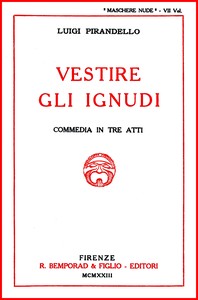
Vestire gli ignudi: Commedia in tre atti by Luigi Pirandello
Luigi Pirandello’s play, Vestire gli ignudi (To Clothe the Naked), is a compact powerhouse of ideas. It doesn't have epic battles or grand settings. Instead, it traps you in a room with a group of people whose lives are upended by a single, questionable story.
The Story
The play opens with Ersilia Drei, a destitute young woman, recovering from a suicide attempt. To the journalist and novelist who take her in, she spins a heartbreaking tale. She speaks of being a governess, of a passionate love affair with a naval officer that ended in betrayal, and of a child’s tragic death that left her with nothing. Moved by her ‘naked’ honesty and suffering, these men are enthralled. They see a perfect, tragic heroine and rush to clothe her in respectability and a new, dignified identity. But as people from her past arrive, the seams of her story begin to split. Different versions of events emerge, and we’re left asking: Is Ersilia a victim telling her truth, or a brilliant performer creating the only identity that will make people care about her?
Why You Should Read It
What blew me away was how current this feels. Pirandello wrote this a century ago, but he’s talking about the stories we tell on social media, the personas we adopt at work, and the way we edit our pasts. Ersilia isn’t just lying; she’s constructing a self that has value in the eyes of others. The men around her aren’t villains—they’re desperate to believe in a beautiful, tragic narrative. The play becomes this tense, uncomfortable dance between what’s true and what’s necessary. You’ll find yourself constantly shifting your opinion of Ersilia, which is exactly the point. Pirandello isn’t giving you a puzzle to solve; he’s showing you how fragile identity really is.
Final Verdict
This is perfect for anyone who loves character-driven stories that stick with you. If you enjoy peeling back the layers of a narrator’s reliability, or if you’ve ever thought about the gap between who you are and who people think you are, you’ll devour this. It’s a short, intense read—more of a long, brilliant short story than a novel—packed with enough psychological insight to fuel a week of conversations. Don’t go in looking for a neat ending; go in ready to be unsettled and fascinated.
This masterpiece is free from copyright limitations. It serves as a testament to our shared literary heritage.
Susan Jones
6 months agoThe layout is perfect for tablet and e-reader devices.
Emily Anderson
11 months agoI appreciate how this edition approaches the core problem, the transition between theoretical knowledge and practical application is seamless. It’s a comprehensive resource that doesn't feel bloated.
Donald Perez
4 months agoI started reading this with a critical mind, the historical context mentioned in the early chapters is quite enlightening. Finally, a source that prioritizes accuracy over hype.
Michael Gonzalez
8 months agoI found the data interpretation to be highly professional and unbiased.

Michael White
3 weeks agoAs a professional in this niche, the nuanced approach to the central theme was better than I expected. It’s hard to find this much value in a single source these days.