
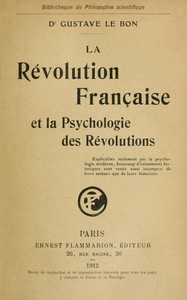
La Révolution Française et la psychologie des révolutions by Gustave Le Bon
Gustave Le Bon's book isn't your typical history of the French Revolution. You won't find a detailed timeline of the Reign of Terror or a biography of Robespierre. Instead, Le Bon uses the revolution as his laboratory. He zooms in on the psychology of the crowds that filled the streets, the sudden collapse of ancient institutions, and how new beliefs replaced old ones almost overnight.
The Story
Le Bon tells the story of how a society's mind breaks and reforms. He starts by explaining his theory of the 'crowd mind'—how individuals in a group lose their critical thinking and become driven by shared emotions and images. Then, he walks through the stages of the revolution, showing how this psychology played out. He looks at how the old monarchy's authority vanished, not just from political pressure, but from a massive shift in what people collectively believed was possible. He examines the radical leaders not as master planners, but as people who intuitively understood how to speak to this new crowd psychology. The story is the transformation of a nation's collective psyche.
Why You Should Read It
I picked this up expecting dry history and got a mind-bender instead. Le Bon's ideas are provocative. When he describes a revolutionary crowd as impulsive, easily swayed, and hungry for simple, powerful images, it’s hard not to think of modern social media or political rallies. His focus isn't on judging the revolution as good or bad, but on understanding the mental mechanics behind it. It makes you look at current events differently. The book can feel dated in its language, and some of his generalizations are broad, but the core question is timeless: How do we behave when we're part of a 'we' instead of an 'I'?
Final Verdict
This book is perfect for anyone fascinated by history, sociology, or politics, but who wants to look beyond the dates and names to the human forces underneath. It's for the reader who wonders why mass movements happen and how ideas gain power. If you enjoy authors like Malcolm Gladwell or Charles Duhigg who explore the hidden patterns of human behavior, you'll find a fascinating (and slightly unsettling) ancestor in Gustave Le Bon. Just be ready to argue with him in the margins—it's that kind of book.
The copyright for this book has expired, making it public property. You do not need permission to reproduce this work.

Richard Lopez
9 months agoA must-have for anyone studying this subject.