
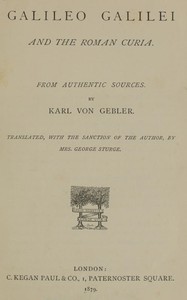
Galileo Galilei and the Roman Curia by Karl von Gebler
Most of us know the headline: Galileo Galilei, the father of modern science, was put on trial by the Catholic Church for defending the Copernican idea that the Earth orbits the Sun. But the real story is so much richer and messier than that simple summary.
The Story
Karl von Gebler's book is built on a mountain of primary sources. He lays out the long, slow-burning conflict that started when Galileo's telescopic discoveries began challenging ancient beliefs. The core of the book follows Galileo's two major clashes with the Roman Curia, the Vatican's administrative body. The first, in 1616, resulted in a warning. The second, the famous trial of 1633, ended with his forced recantation and house arrest. Gebler shows this wasn't a sudden arrest; it was a protracted battle of wills, filled with failed negotiations, shifting alliances, and bureaucratic maneuvering. We see Galileo not just as a genius, but as a flawed man navigating a political minefield.
Why You Should Read It
What makes this book stand out is its focus on the people and the paperwork. Gebler translates the legal and theological arguments into a compelling narrative. You feel the frustration of the Church officials trying to manage this brilliant but troublesome celebrity. You see Galileo's clever attempts to work within the system, and his ultimate miscalculation. The tension isn't manufactured; it's right there in the meeting minutes and personal correspondence. It completely reframes the event from a symbolic 'war' between science and faith into a specific human drama about authority, communication, and the cost of truth.
Final Verdict
This is a must-read for anyone who loves a deep, document-driven historical story. It's perfect for history buffs who want to move beyond textbook summaries, for readers interested in the history of science, or for anyone who enjoys a real-life story about an underdog facing a powerful institution. Be prepared: it's detailed and spends time with 17th-century theology, so it requires a bit of focus. But if you stick with it, you'll come away with a much deeper, more nuanced understanding of one of history's most famous confrontations.
Legal analysis indicates this work is in the public domain. You can copy, modify, and distribute it freely.
Edward Nguyen
1 year agoRead this on my tablet, looks great.
Karen Clark
7 months agoEnjoyed every page.


Sarah Thompson
1 year agoThis is one of those stories where the storytelling feels authentic and emotionally grounded. Truly inspiring.